







Luxembourg’s Police Surge Meets a New Age of Crime
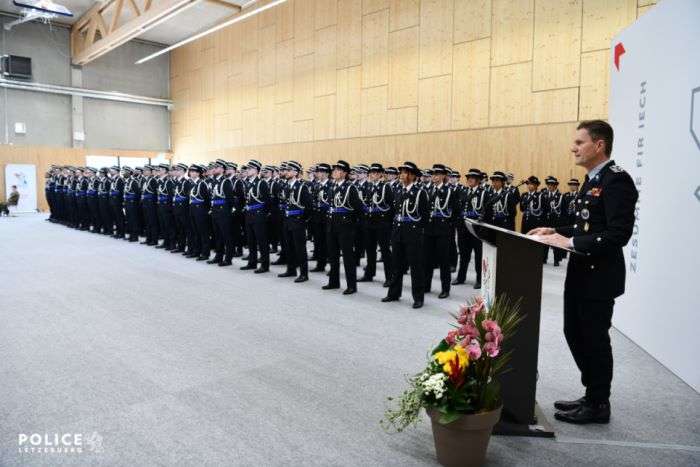
The swearing-in of 144 new officers into the Grand Ducal Police this April, in the presence of Luc Frieden and Léon Gloden, is more than ceremonial theatre. It is a signal that Luxembourg understands the pressure building beneath its polished reputation as one of Europe’s safest states. Yet recruitment alone is not reform. The real question is whether the structure, training, and operational philosophy of Luxembourg’s police are evolving quickly enough to meet the changing character of crime.
The numbers are, on the surface, reassuring. Since 2020, roughly 200 recruits have been trained annually, with intakes of 176 in 2023, 170 in 2024, and 159 in 2025. The addition of 144 operational officers now entering the field appears to strengthen capacity at a time when population growth, cross-border mobility, and digitalisation are reshaping public security demands. The government’s emphasis on the “four Ps” — personnel, presence, proximity, and prevention — reflects a modern policing doctrine that prioritises visibility and community trust.
But this framework risks being overly comfortable in a rapidly shifting threat environment. Luxembourg is no longer dealing primarily with low-level crime or predictable public order issues. Financial crime, cyber-enabled fraud, organised trafficking networks, and cross-border criminal mobility increasingly define the landscape. As a global financial hub, the country is particularly exposed to sophisticated economic crime that requires specialised investigative skills rather than generalist policing instincts.
Against that backdrop, the current training model deserves scrutiny. A two-year training cycle, or one year for certain categories, aligns with European norms but raises questions about depth versus speed. Training duration alone is not the issue. It is what is taught within that period and how adaptable that training remains once officers are deployed. Traditional curricula that emphasise physical policing, procedural law, and routine patrol duties may no longer be sufficient. Modern officers need competencies in digital forensics, financial investigation, intelligence analysis, and cross-border legal cooperation.
Here, Luxembourg risks lagging behind some of its neighbours. In France, reforms following high-profile security challenges have pushed for expanded intelligence capabilities and specialised anti-terror and cybercrime units. Belgium has invested heavily in integrated police databases and inter-agency coordination, particularly after past failures exposed fragmentation in its policing system. Germany, with its federal structure, has increasingly prioritised advanced training in cybercrime and financial investigations at both state and federal levels.
Luxembourg’s smaller size can be an advantage, allowing for quicker institutional adaptation. Yet it can also breed complacency, particularly when crime rates remain comparatively low. The danger lies in underestimating the sophistication of modern criminal networks that exploit precisely such environments — stable, wealthy, and perceived as low-risk for enforcement.
The yardstick for the “average” Luxembourgish police officer must therefore be redefined. It is no longer enough for officers to be competent in patrol duties and basic investigative procedures. The baseline must include digital literacy, the ability to interpret financial data, and familiarity with international cooperation mechanisms such as Europol frameworks. Language skills, already a strength in Luxembourg, should be further leveraged as a strategic asset in cross-border investigations.
There is also the question of institutional culture. Recruitment numbers suggest that policing remains an attractive career, but attraction is not the same as transformation. A modern police force must cultivate continuous learning rather than rely on initial training as a foundation that lasts an entire career. This requires structured professional development, regular re-certification in specialised areas, and incentives for officers to acquire advanced skills.
Another area requiring attention is investigative capacity. Increasing patrol presence may improve public perception of safety, but it does little to dismantle complex criminal networks. Luxembourg must invest more heavily in specialised units that can handle financial crime, cybercrime, and organised trafficking. This includes not only personnel but also technology, data analytics tools, and legal frameworks that allow for efficient prosecution.
Coordination with judicial authorities is equally critical. Effective policing does not end with arrest. It must translate into successful prosecution. This demands tighter integration between investigators and prosecutors, particularly in cases involving cross-border evidence and digital data. Delays or gaps in this chain can undermine even the most sophisticated police work.
The recent recruitment drive is therefore a necessary step, but it should not be mistaken for a sufficient one. Luxembourg is expanding its police force at a time when the nature of crime is becoming more complex, less visible, and more transnational. The country’s strategy must evolve from one centred on numbers and presence to one driven by capability and specialisation.
If Luxembourg is to maintain its reputation for safety, it must think beyond the immediate optics of new uniforms on the street. It must invest in the unseen dimensions of policing — intelligence, technology, training depth, and institutional agility. The challenge is not simply to keep pace with crime, but to anticipate it.
Anything less risks leaving a well-staffed but underprepared force facing a future that demands far more than presence alone.
Photo – © Police grand-ducale