


Blockading the Blockade: Trump’s “Epic Fury”
The unfolding confrontation around the Strait of Hormuz has revealed less about Iranian aggression than policy incoherence on the part of US President Donald Trump and Israeli Prime Minister Benjamin Netanyahu. What has been branded, with characteristic bombast, as “Operation Epic Fury” appears less a strategy than an improvisation driven by political instinct, personal impulse, and a fundamental misreading of regional realities. The so-called “blockade against the blockade” stands as a particularly glaring example of this anti-logic, an idea that collapses under even cursory scrutiny.
To blockade a chokepoint already contested by a regional power such as Iran is to misunderstand both geography and military feasibility. The Strait is not a static target to be stormed by superior naval tonnage. It is a dynamic, asymmetric battlespace in which smaller forces, mines, missiles, and regional alliances can offset conventional superiority. The assumption that American naval power can impose unilateral control ignores decades of Iranian planning precisely for this scenario. Tehran has long factored disruption of maritime traffic into its deterrence doctrine. In effect, Washington’s policy does not outmaneuver Iran’s strategy. It walks directly into it.
The economic consequences are equally predictable. Any sustained disruption in the Strait would trigger a sharp escalation in global oil prices, a reality deeply embedded in Iranian strategic thinking. A spike in crude prices would not merely punish Western economies but also fracture the fragile alignment among U.S. partners in the Gulf. States such as Saudi Arabia, United Arab Emirates, and Qatar depend on stable export routes. Their implicit bargain with Washington has always been security in exchange for alignment. Yet the present crisis exposes a troubling asymmetry. These states find themselves vulnerable not only to Iranian retaliation but also to spillover disruptions from actors such as the Houthis at the mouth of the Gulf of Aden. The promise of American protection appears increasingly theoretical.
The diplomatic dimension is no less troubling. Reports of J. D. Vance conducting negotiations while tethered to real-time instructions from Mar-a-Lago suggest a hollowing out of institutional process. Diplomacy reduced to a relay of phone calls is diplomacy stripped of coherence. It reflects a broader deinstitutionalization of American statecraft, where decisions of war and peace are shaped less by structured deliberation than by the impulses of a single actor. This personalization is compounded by the influence of Netanyahu, whose own strategic record raises serious questions. Israel’s inability to decisively neutralize Hezbollah in Lebanon underscores the limits of force against entrenched, networked adversaries. Yet the same logic is now being extended toward Iran, a far larger and more complex state.
The notion of “decapitation” as a viable strategy against Iran betrays a misunderstanding of its political and social fabric. Unlike smaller or more fragmented entities, Iran’s order has demonstrated resilience under sustained external pressure. Attempts at regime destabilization, whether through sanctions or kinetic strikes, have historically reinforced internal cohesion rather than weakened it. The expectation that airpower and coercion alone can induce systemic collapse is not a strategy. It is wishful thinking.
Meanwhile, Europe’s posture adds another layer of concern. The European Union remains tethered to NATO as the cornerstone of its security architecture, yet appears politically diminished in its capacity to influence outcomes. The reliance on American guarantees persists despite mounting evidence of their unpredictability. European leaders, often elevated through consensus-driven political systems that reward conformity over strategic depth, struggle to articulate an independent course. The result is a continent that echoes rather than shapes policy, even when its own economic and security interests are directly at stake.
This dependency has broader implications. The crisis in Ukraine and the severing of energy ties with Russia have already exposed the costs of strategic alignment without autonomy. Now, as tensions escalate in the Gulf, Europe risks repeating the pattern. If American assurances prove unreliable in protecting Gulf partners from a regional power like Iran, what confidence can be placed in those same assurances against a major power adversary?
The impracticality of extending “blockading the blockade” into the Caspian Sea becomes even clearer when one considers the dense web of energy and trade infrastructure anchored on Iran’s northern coast. Ports such as Neka, Amirabad and Bandar Anzali are not peripheral outposts. They are integrated logistics hubs tied to pipelines, rail corridors and multimodal routes linking Iran to Russia, Kazakhstan, Turkmenistan and Azerbaijan.
At the core lies the Neka terminal, connected by a 400-kilometre pipeline to refineries in Tehran and Tabriz, enabling swap operations that have historically reached up to 100,000 barrels per day and beyond . Through this system, crude delivered from Central Asia is refined in northern Iran while equivalent volumes are exported via southern terminals. This is not merely trade. It is a logistical arbitrage network that binds the Caspian to the Persian Gulf.
These ports are embedded in the wider International North–South Transport Corridor, a multimodal system combining sea, rail and road links that facilitates the movement of oil, grain, metals and industrial goods between Russia, Iran and onward markets in Asia. Maritime traffic is supported by a growing fleet of Iranian and Russian vessels, port expansions in Astrakhan and Anzali, and financial infrastructure designed to bypass sanctions . Even grain flows underscore the scale of activity, with millions of tons moving annually across this corridor .
The Caspian is therefore not an isolated Lake, but a functioning economic artery. Energy swaps, LNG cooperation, petroleum product flows and industrial cargo all move through a network that is already politically shielded by Moscow’s dominance and increasingly backed by Beijing’s strategic interests. Any attempt to project American naval coercion into this enclosed space would collide directly with entrenched regional systems that are neither fragile nor easily disrupted.
In this light, the Caspian dimension exposes the deeper absurdity of “Operation Epic Fury’s” blockading the blockade policy. It is not simply that the United States lacks the means to enforce such a policy there. It is that the region is already structured around an alternative order, one in which Iran is not isolated but embedded. To challenge that order is not to pressure Tehran alone. It is to confront the combined strategic weight of Russia and, potentially, China.
The likely trajectory of the current policy is not escalation to decisive conflict but gradual collapse under its own contradictions. The idea that a limited U.S. naval presence can enforce a comprehensive blockade against a stream of tankers, potentially including those linked to China or Russia, strains credibility. The logistical and legal challenges alone are formidable. The prospect of boarding and detaining dozens of vessels in international waters, thousands of kilometers from U.S. shores, borders on the implausible. Unlike Venezuela, the Gulf presents a far more complex and contested environment.
In the end, the rhetoric may prove louder than the reality. The pattern of maximalist threats followed by reluctant recalibration suggests that the current posture is unsustainable. What is presented as resolve may in fact be a prelude to retreat. The tragedy lies not only in the risk of conflict but in the erosion of strategic wisdom. A policy that seeks to blockade a blockade, to coerce without leverage, and to dominate without understanding is not merely flawed. It is self-defeating.
Bitjoka Bondol Mboc / David Danisa
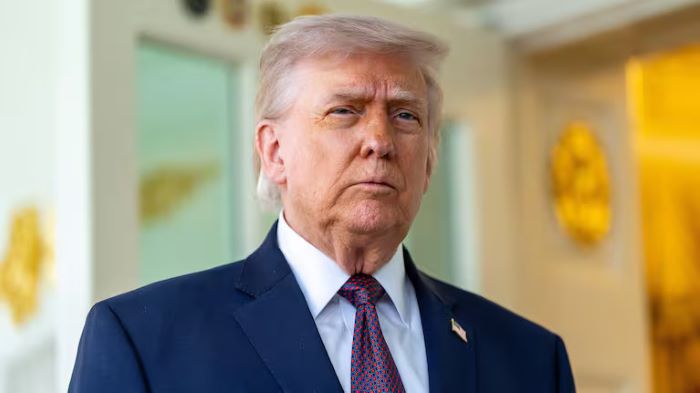
Photo – US President Donald Trump (Source: Associated Press)