




Small State, Big Dilemma
Luxembourg’s decision to establish a €150 million defense fund reflects a broader European shift toward increased military spending under NATO commitments. On the surface, the initiative appears pragmatic. It seeks to retain a portion of defense expenditure within national and European industrial ecosystems while supporting innovation in areas such as cybersecurity, space technologies, and advanced materials. Yet beneath this strategic framing lies a deeper structural problem within Europe’s defense posture, one that raises doubts about the effectiveness of such investments when detached from coherent military doctrine and integrated planning.
Luxembourg’s approach is emblematic of a wider European model that attempts to reconcile economic policy with defense imperatives. By prioritizing “dual-use” technologies and fostering domestic suppliers, the government is not simply investing in security but also in industrial policy. This blending of economic and defense objectives is not inherently flawed. In fact, it mirrors successful historical precedents where military innovation drove broader technological advancement. However, in the current European context, the balance appears skewed. Defense spending is increasingly justified through economic multipliers and job creation rather than strategic necessity. This raises the question of whether such funds are designed to address genuine security challenges or to serve as instruments of industrial policy under the guise of defense.
The European defense landscape is fragmented. Unlike the United States, which maintains a relatively unified military-industrial complex guided by a central strategic doctrine, Europe operates through a patchwork of national systems, each with its own political priorities and industrial interests. Luxembourg’s fund explicitly aims to integrate into wider European value chains, but these chains themselves are often inefficient and duplicative. Multiple countries develop similar capabilities independently, leading to redundancy and increased costs. The absence of a unified procurement strategy undermines the potential benefits of increased spending.
Compounding this issue is the growing influence of private defense contractors and consultancy networks. In many European countries, these actors play a significant role in shaping procurement decisions and strategic priorities. Their motivations, rooted in profit maximization, do not always align with long-term security needs. The result is a system where military hardware acquisition is often driven more by market dynamics than by operational requirements. Luxembourg’s intention to invest in innovative companies may inadvertently reinforce this trend, particularly if oversight mechanisms fail to ensure alignment with national and allied defense strategies.
The marginalization of military expertise further exacerbates these challenges. Defense policy in Europe has increasingly become the domain of political actors, with military professionals often relegated to advisory roles. While civilian control of the military is a cornerstone of democracy, the current imbalance risks sidelining essential strategic insights. Military planning, traditionally grounded in geopolitical constants such as geography, force projection capabilities, and adversary analysis, is now frequently influenced by short-term political considerations. This substitution of enduring strategic variables with fluctuating political priorities undermines the coherence of defense policy.
Luxembourg, despite its small size, is not immune to these dynamics. Its defense establishment operates within a broader European framework where decision-making is diffused across multiple levels. The creation of a national defense fund does little to address the underlying issue of strategic fragmentation. Without a clear articulation of Luxembourg’s role within NATO and European defense structures, such investments risk becoming symbolic gestures rather than substantive contributions to collective security.
Moreover, the emphasis on integrating Luxembourgish companies into European supply chains raises questions about dependency and autonomy. While participation in these networks can enhance technological capabilities, it also ties national defense outcomes to external actors and market conditions. In times of crisis, such dependencies may prove problematic, particularly if supply chains are disrupted or if allied priorities diverge.
The effectiveness of Europe’s current model ultimately hinges on its ability to reconcile economic, political, and military objectives within a coherent strategic framework. Increased spending alone is insufficient. Without structural reforms that enhance coordination, prioritize strategic clarity, and reintegrate military expertise into decision-making processes, the impact of such investments will remain limited.
Luxembourg’s defense fund is a microcosm of this broader challenge. It reflects both the ambitions and the contradictions of European defense policy. On one hand, it demonstrates a commitment to strengthening capabilities and contributing to collective security. On the other, it highlights the persistent reliance on market-driven solutions and politically mediated decision-making.
In the absence of a more integrated approach, Europe risks perpetuating a system where defense spending increases without corresponding gains in effectiveness. For Luxembourg, the challenge is not merely to invest wisely but to ensure that such investments are embedded within a strategic vision that transcends national and economic considerations.
David Danisa (CityNews)
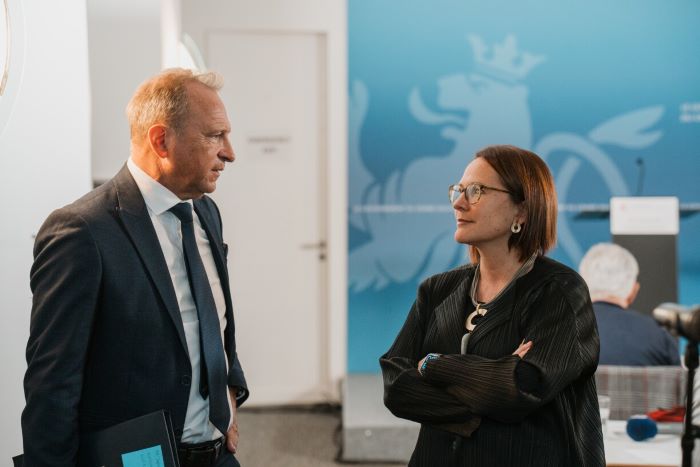
Photo – Gilles Roth et Yuriko Backes photographiés lors de la conférence de presse dédiée au “Defence Bond” le 15 janvier 2026. © MFIN