







Regional Crisis Underway in the Middle East
Reports that Iran has launched missiles toward a British military installation in Cyprus – widely believed to be RAF Akrotiri – mark a dramatic escalation in an already combustible regional crisis. The incident, unfolding amid claims of sustained Iranian military action across Arab states and the reported death of Ayatollah Ali Khamenei, has triggered urgent questions about motive, command, and the wider geopolitical consequences.
Why strike a British target? Strategically, such a move signals both reach and intent. Britain remains a close ally of Washington and maintains a significant military footprint across the eastern Mediterranean and Gulf region. A strike – or attempted strike – on a UK base carries symbolic weight – it internationalises the confrontation, expands the field of deterrence, and signals that Tehran’s anger is not confined to immediate adversaries. It is also a warning that Western military infrastructure across the region could be drawn into any widening conflict.
The deeper question, however, concerns the internal state of Iran itself. If senior political and military figures have indeed been killed in recent attacks – alongside the reported loss of its supreme leader the country may be facing one of the most profound leadership crises since the 1979 revolution. Iran’s power structure rests on a delicate balance between clerical authority, the Revolutionary Guards, and state institutions. Removing or destabilising any of these pillars risks fragmentation, factional rivalry, or a surge in hardline retaliation designed to project strength amid uncertainty.
Historically, moments of internal shock in Tehran have often been followed by outward displays of force. Military escalation can serve multiple purposes – deterrence against perceived external opportunism, consolidation of domestic unity, and reassurance to ideological supporters across the region. What may appear externally as unrestrained aggression can, internally, function as political survival.
Yet the crisis is not unfolding in isolation. The question of external responsibility and whether the current violence represents another phase of confrontation driven by Donald Trump and Israel – is already shaping global debate. Tehran has long viewed both actors as central to efforts to weaken or contain it. Any direct or indirect role attributed to them in the deaths of Iranian leadership figures would almost certainly intensify retaliatory pressure across multiple theatres – the Gulf, the Levant, and beyond.
Whether Washington remains “in control” of the situation depends largely on what control now means. Modern regional conflicts rarely unfold along clear command lines. Military action, proxy forces, cyber operations and political messaging intersect in ways that no single power can fully regulate once escalation begins. Even close allies often pursue parallel and sometimes competing strategies. What may have begun as targeted deterrence can quickly evolve into multi-front instability.
What, then, could restrain Iran’s anger?
Historically, three forces have moderated Iranian escalation – credible deterrence, internal political calculation, and diplomatic off-ramps. Military pressure alone rarely compels restraint unless accompanied by clear pathways to de-escalation. Economic vulnerability can influence strategic choices but only over time. Immediate calming of tensions typically requires negotiation channels – whether public or covert, that allow all sides to step back without appearing to surrender.
Timing is critical. The longer a leadership vacuum or internal power struggle persists, the greater the likelihood that external confrontation becomes a tool of internal legitimacy. Conversely, rapid consolidation of authority in Tehran could produce either restraint or more disciplined escalation but uncertainty would diminish.
The potential consequences of a supreme leader’s death are far-reaching. Iran’s ideological direction, nuclear posture, regional alliances and domestic governance could all shift. Succession struggles might redraw political alignments within the clerical establishment and security apparatus. Regional proxy networks could act more aggressively, or more independently – if command coherence weakens. Energy markets, maritime security and diplomatic relations across the Middle East would all feel the impact.
For neighbouring states and global powers alike, the central concern is no longer simply retaliation but unpredictability. A leadership transition under fire, combined with expanding military confrontation, creates the conditions for miscalculation – the most dangerous force in geopolitics.
Whether this moment becomes a contained crisis or the opening phase of a wider regional conflict will depend less on any single strike than on how quickly authority stabilises in Tehran, how clearly red lines are communicated, and whether diplomacy can re-enter a space currently dominated by missiles.
For now, the region watches a volatile equation still being written – one in which power, grief, deterrence and ambition are moving faster than any certainty.
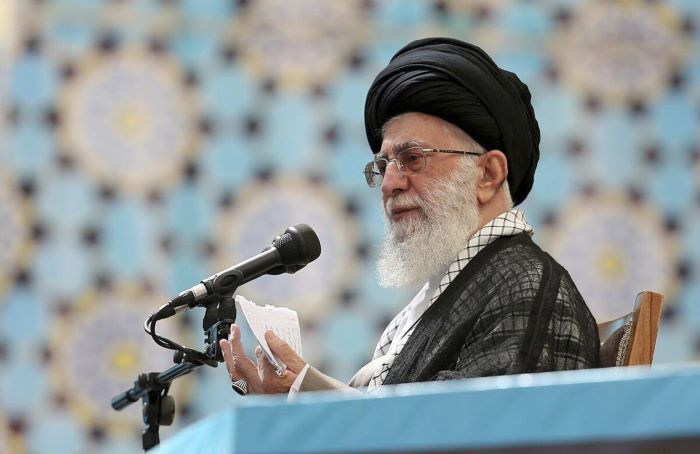
In this picture released by the official website of the office of the Iranian supreme leader, Supreme Leader Ayatollah Ali Khamenei speaks at a ceremony marking the 25th anniversary of the death of the late Ayatollah Khomeini at his shrine just outside Tehran on Wednesday.
(Uncredited / Associated Press)