


“The Strait of Hormuz and the Fate of Multipolarity”
The war against Iran may ultimately be remembered not as another Middle Eastern conflict but as a decisive chapter in the struggle over the future structure of the international system. While much commentary in the West continues to frame the confrontation in terms of nuclear proliferation, regional security, or Iranian domestic politics, the deeper geopolitical significance lies elsewhere. What is unfolding is a test of whether the emerging multipolar order can survive a direct challenge at what many Western strategists have long regarded as its most vulnerable point.
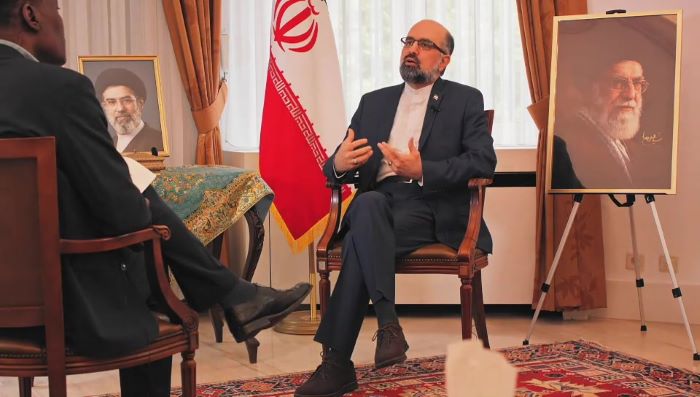
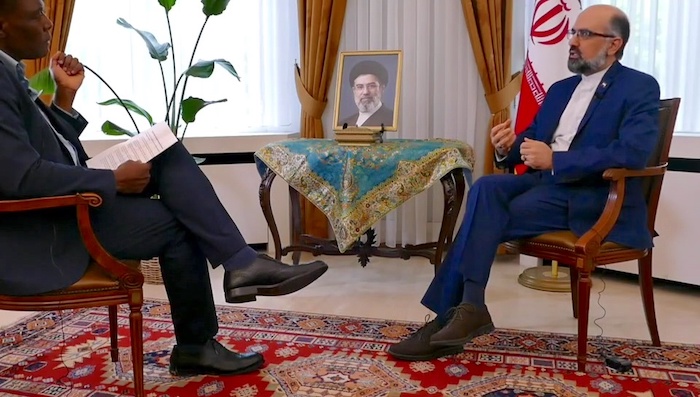
In my recent interview with the Ambassador of the Islamic Republic of Iran to Belgium, Luxembourg and the European Union, His Excellency Seyed Mohammad Ali Robatjazi, one remark stood out above all others. Reflecting on the crisis in the Strait of Hormuz, he argued that the world is witnessing a moment in which “the birth of multipolarity or the killing of multipolarity” may be decided. Whether one agrees with Tehran’s perspective or not, the observation deserves serious consideration.
For decades, Western strategic thinking has regarded Russia as the principal military obstacle to global unipolarity and China as its principal economic challenger. Direct military confrontation with either power risks escalation on a scale that no rational actor can contemplate. Iran, however, occupies a different position. It is powerful enough to matter, influential enough to shape events across Eurasia and the Middle East, yet seemingly vulnerable enough to be targeted without immediately triggering a nuclear confrontation.
This makes Iran the logical pressure point.
The methods employed against Iran are not new. They are recognisable from previous confrontations with both Russia and China. First comes the information war. The Iranian state is presented as uniquely authoritarian, uniquely oppressive, and uniquely illegitimate. During our conversation, Ambassador Robatjazi argued that Western media portrayals of Iran bear little resemblance to realities on the ground and serve a broader political purpose. Whether one accepts this claim entirely or only in part, it is difficult to ignore the selective nature of Western criticism.
Iran is routinely condemned as undemocratic, yet many Western allies in the Persian Gulf operate political systems that are far less participatory. Iran possesses elections, a parliament, constitutional structures, a functioning judiciary and legally recognised minority representation. These institutions are certainly debated and criticised within and outside Iran, but they exist. Similar patterns of political delegitimisation were directed at Russia before the Ukraine conflict and are increasingly visible in Western narratives concerning China.
The second element is strategic encirclement. Iran finds itself surrounded by American military installations, naval deployments and allied security structures. Tehran interprets these developments as preparations for coercion. The pattern is again familiar. Russia witnessed NATO expansion following the collapse of the Warsaw Pact. China observes increasing military cooperation around Taiwan and the Western Pacific. Different regions, different actors, but remarkably similar strategic templates.
The significance of Iran, however, extends beyond contemporary geopolitics. As Ambassador Robatjazi repeatedly emphasised, Iran sees itself not merely as a nation-state but as the continuation of an ancient civilisation. He spoke of justice-seeking, independence and resistance to domination as characteristics rooted in Iranian civilization long before the establishment of the Islamic Republic.
This civilisational dimension is frequently underestimated in Western capitals. Modern geopolitical analysis often assumes that states behave primarily according to calculations of material gain. Yet civilisational states operate differently. Their policies are shaped not only by immediate interests but also by historical memory, identity and long-term cultural continuity.
Iran therefore represents something larger than a government or a regime. In the Iranian view, resistance is not simply a policy. It is an expression of historical identity.
This helps explain why sanctions, assassinations and military pressure have failed to produce the political collapse repeatedly predicted by external observers. During the interview, Ambassador Robatjazi rejected the notion that eliminating scientists, officials or military leaders could destroy the Islamic Republic. The source of resilience, he argued, lies in the population’s perception that the country is defending its sovereignty against external domination.
Whether one agrees with this assessment or not, history offers numerous examples of societies becoming more cohesive when confronted by foreign pressure.
The broader question concerns the future of global order. Classical geopolitical theories, particularly those associated with Sir Halford Mackinder, emphasised control over Eurasia as the key to global dominance. Yet Mackinder’s framework emerged from a distinctly Western understanding of power, one built around the concept of control itself.
The emerging partnership among Moscow, Beijing and Tehran may not fit neatly within that framework. Their cooperation is based less on constructing a unified bloc than on resisting a world order dominated by a single centre of power. This distinction is important. Western strategists often assume that opposition to American primacy automatically implies the desire to establish a rival hegemony. The reality may be more complex.
If Iran can withstand sustained military, economic and political pressure, the consequences will extend far beyond the Middle East. It would reinforce the perception that even concentrated Western power can no longer dictate outcomes unilaterally. Multipolarity would gain credibility as an enduring reality rather than a theoretical possibility.
Conversely, if Iran is strategically neutralised, isolated from its partners and reduced to a compliant regional actor, the message will resonate across the international system. States seeking strategic autonomy would conclude that resistance carries unacceptable costs. The appeal of alignment with the existing Western-led order would increase.
This is why the struggle surrounding Iran has become so consequential. The issue is not merely uranium enrichment, regional influence or even the future of the Islamic Republic. At stake is a larger historical question about the distribution of power in the twenty-first century.
The Strait of Hormuz is more than a maritime chokepoint. It has become a geopolitical symbol. It is the point at which competing visions of world order now meet. In that narrow waterway, and in the confrontation surrounding Iran itself, the future balance between unipolarity and multipolarity may ultimately be decided.
David Danisa (CityNEWS)