







Germany’s Wage Surge: What It Means for Luxembourg
Germany’s planned minimum wage increases, set to reach €14.60 per hour by 2027, mark a notable economic adjustment with far-reaching effects. As Germany edges closer to Luxembourg’s wage levels, the policy’s probable and possible impacts on both German cross-border workers and Luxembourg’s labor market merit careful examination.
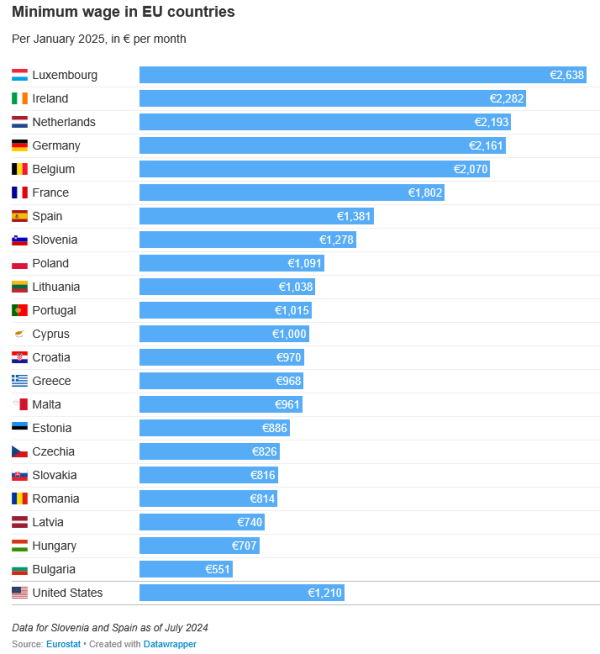
The immediate implication is that Germany’s labor market is striving to become more competitive, particularly against Luxembourg, which has long been a magnet for workers due to its higher wages, lower taxes, and generous social benefits. Currently, around 220,000 cross-border workers, many from Germany, travel daily into Luxembourg, attracted by a statutory minimum wage of €2,638 per month, the highest in the EU. Germany’s phased increases — first to €13.90 per hour in 2026, then €14.60 in 2027 — will still leave its wages slightly below Luxembourg’s, but they significantly narrow the gap.
A critical outcome could be a moderate decline in the number of Germans commuting to Luxembourg. Especially in regions like Saarland and Rhineland-Palatinate, workers in lower-wage sectors might reconsider daily cross-border travel if German wages rise enough to offset commuting costs and the value of their time. This could marginally reduce Luxembourg’s reliance on German labor in industries that depend on these workers to fill positions that local residents may not be willing to take.
However, the extent of this shift is likely to be limited. Despite Germany’s wage hike, Luxembourg still holds substantial advantages beyond pay. Its lower tax burden and stronger welfare provisions continue to make cross-border work attractive. Many Germans may find that even with higher wages at home, the net benefit of working in Luxembourg remains considerable. Thus, the pull of Luxembourg’s labor market will persist, though perhaps with slightly less force at the lowest wage levels.
From Luxembourg’s perspective, these developments carry both probable and possible economic consequences. In the short term, there could be some tightening of the labor supply if fewer German workers opt to cross the border. Sectors such as hospitality, retail, and certain administrative services that heavily rely on German employees might experience hiring pressures. Employers may need to raise wages or offer additional incentives to retain and attract staff, adding to operational costs in a country already grappling with high living expenses.
Looking more broadly, Luxembourg’s dependence on a trained and mobile workforce from Germany underscores the structural nature of this cross-border dynamic. Even a gradual reduction in incoming workers could challenge Luxembourg’s growth model, which banks on steady access to external labor to fuel its economy. Luxembourg might respond by further enhancing its employment appeal, possibly through targeted tax adjustments or policies that deepen integration with neighboring labor markets.
There are also secondary risks and opportunities. German companies near the border may find it easier to hire locally if fewer residents leave daily for Luxembourg, potentially easing some domestic labor shortages. Meanwhile, Luxembourg’s firms may become more aggressive in talent acquisition, seeking to lock in skilled German workers through perks and long-term contracts before the wage differential closes further.
At the EU level, Germany’s move may spark ripple effects, increasing pressure on other member states to consider similar adjustments to avoid labor market distortions and maintain competitiveness. This could recalibrate wage structures across the region, subtly shifting the economic landscape on which Luxembourg’s model depends.
Ultimately, Germany’s wage increases reflect both an economic and a political response to domestic challenges of rising living costs and working poverty. For Luxembourg, the probable impact is a modest softening of cross-border labor inflows, while the possible longer-term consequence could involve structural adaptations to preserve its economic vitality. The interplay of these changes highlights how interconnected and sensitive the region’s labor markets are, with even incremental shifts in one country setting off adjustments in its neighbors.