







Probing World’s Oldest Ice Core for New Clues to Earth’s Climate Future”
An Antarctic ice core that may be more than 1.5 million years old has arrived in the
United Kingdom, where scientists will begin melting and analyzing it to unlock
unprecedented data about Earth’s climate history. Believed to be the oldest intact ice
ever recovered, the glassy cylinder was extracted from deep within the East Antarctic
Ice Sheet and is expected to shed light on long-standing mysteries surrounding the
planet’s natural climate cycles.
The ice core contains trapped air bubbles and particles dating back to the Mid-
Pleistocene Transition, an era when Earth’s ice age cycle shifted from occurring every
40,000 years to every 100,000 years. Understanding why that change happened is one
of the key objectives of the research, which is part of the European Beyond EPICA
project.
By examining ancient concentrations of greenhouse gases such as carbon dioxide and
methane, scientists hope to better understand how natural factors influenced the
planet’s climate over a million years ago. This could help clarify the role of atmospheric
gases in driving ice ages and reveal how sensitive the Earth’s climate is to rising CO₂
levels – an issue of pressing concern today.
“Looking at past climate periods will help us model what lies ahead,” said Dr. Robert
Mulvaney, one of the UK-based researchers involved in the project. “This core has the
potential to rewrite what we know about Earth’s climate system.”
Researchers say the data may help refine climate prediction models, inform global
policy decisions, and even identify potential tipping points, thresholds in the climate
system that, once crossed, could trigger irreversible changes such as large-scale ice
sheet collapse or Amazon rainforest dieback.
Analysis of the core is expected to take several years. Scientists will first begin with
careful melting and gas extraction, followed by high-resolution chemical and isotopic
analyses. Early results may emerge within the next 12 to 24 months.
While the core itself cannot reverse climate change, experts believe it could provide vital
insight to support more effective global responses.
“This is a major step in understanding the Earth’s climate engine,” said Carlo Barbante,
coordinator of the Beyond EPICA project. “We are not just learning about the past, we
are trying to protect the future.”
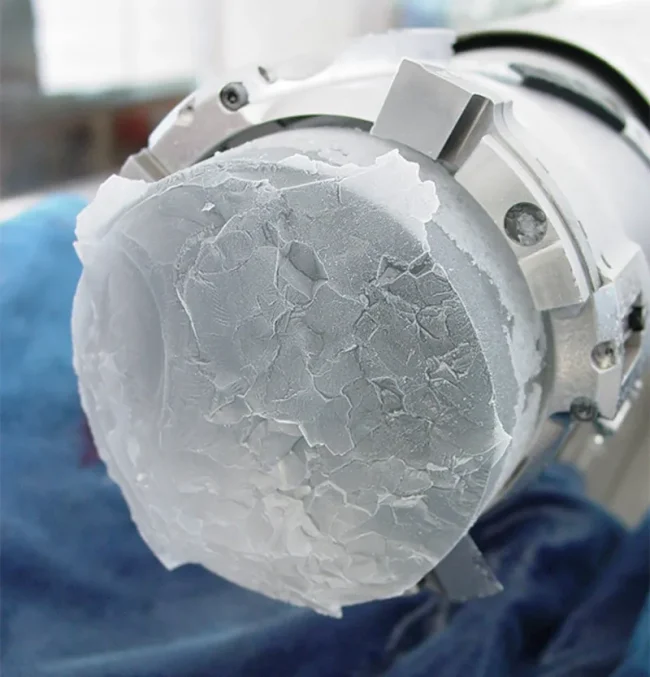
Image – The original EPICA project drilled an 800,000-year-old ice core between 1996 and 2005 (Laurent AUGUSTIN/CNRS)