








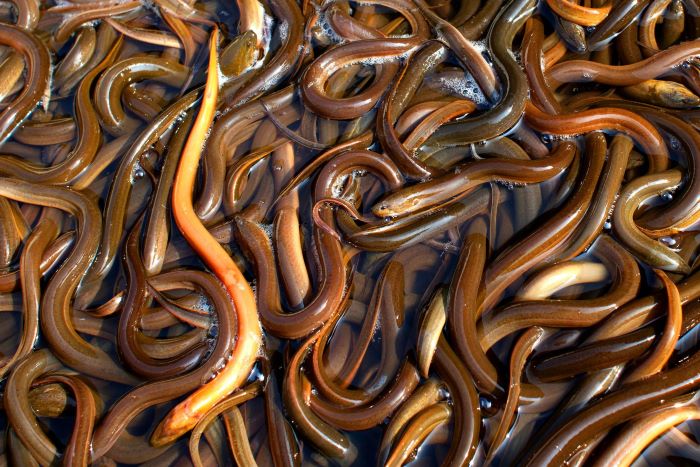
The Illegal Billion-Dollar Eel Trade, Fueling a Global Delicacy
Deep in the heart of Europe’s political capital, a darker, more clandestine trade is
flourishing, one that has made Belgium a critical hub in a global criminal network worth
billions. The commodity is not drugs or weapons, but tiny, transparent fish known as
“glass eels.” These juvenile European eels, a critically endangered species, are being
trafficked in staggering numbers from European rivers to the aquaculture farms of
China, where they are raised for a voracious and highly profitable Asian market.
The scale of the operation is immense and its sophistication rivals that of any major
drug cartel. Law enforcement agencies, including Europol and national police forces,
have spent years unraveling a complex web of fishermen, smugglers, and financiers.
Recent raids and arrests across Europe, with a particular focus on the networks
operating out of Belgium, have finally begun to shed light on the mechanics of this illicit
trade.
In a recent case brought before the Brussels Correctional Court, a criminal network was
dismantled, with ten individuals receiving prison sentences ranging from two to four
years. Their crime – smuggling 290 kilograms of glass eels out of Zaventem Airport. The
method was simple yet brazen, eels were packed into plastic bags with oxygen and
placed in suitcases alongside frozen water bottles to keep them cool. The destination?
Doha, a transit point on the way to their final resting place in Asia. This single seizure,
authorities say, was just a small slice of a much larger pie.
Experts and law enforcement officials estimate the illegal eel trade can generate up to
€3 billion in peak years, making it one of the most lucrative wildlife crimes on the planet.
The profits are extraordinary. A kilogram of glass eels, which can contain thousands of
individual fish, can fetch upwards of €5,000 on the black market in Asia. The risk, for a
species that is not as well-known as rhinos or elephants, is deemed a worthwhile
gamble by organized crime syndicates that have moved into the trade, attracted by the
high returns and comparatively lighter sentences for wildlife crime.
The journey of a glass eel begins in the rivers and estuaries of Europe, where
fishermen, both licensed and illicit, harvest them in huge quantities. The European eel,
Anguilla anguilla, is a species with a truly epic life cycle. It is born in the Sargasso Sea
and drifts on ocean currents for thousands of miles before arriving as a tiny, translucent
creature on European shores. It then swims upstream to spend years in freshwater
before returning to the sea as an adult to spawn. This remarkable migratory cycle has
been fatally interrupted by overfishing and the illegal trade. Since 2010, the European
Union has had a strict ban on the export of European eels, whether live or dead, to
countries outside the bloc.
However, the thriving black market has emerged to circumvent this ban, with Belgium
playing an increasingly prominent role. Law enforcement sources suggest that the
country’s strategic location and well-connected transport infrastructure make it an ideal
transit point. The networks use airports like Zaventem, and sometimes seaports, to ship
their valuable cargo. The eels are often mislabelled on shipping manifests, disguised as
other seafood, or simply smuggled in luggage by a network of couriers.
A recent report by the wildlife trade watchdog TRAFFIC highlighted the worrying trend,
with a significant proportion of the more than 1 million eels seized by EU authorities in a
single year passing through Belgium. The networks are highly organized and often
involve a mix of European and Asian players. In the dismantled Brussels-based gang,
investigators found that Asian intermediaries, with a base in the Paris region, were
orchestrating the smuggling, with Zaventem Airport being a key departure point.
The environmental consequences are catastrophic. The European eel population has
plummeted by an estimated 90% since the 1970s. The removal of these juvenile eels
from the wild at such a critical stage of their life cycle is a direct threat to the species’
survival. Conservationists warn that every glass eel taken is a potential adult that will
never return to the Sargasso Sea to reproduce. The impact extends beyond the species
itself, as the loss of eels disrupts the delicate ecological balance of the freshwater
habitats they inhabit, leading to a “cascade of effects.”
While law enforcement agencies have made significant strides, the battle is far from
over. The immense profits and relatively low risk continue to draw criminal gangs. For
every successful raid and prosecution, countless other shipments likely slip
through the net. As the global demand for eel continues to grow, so too does the
pressure on this critically endangered species. The fight to save the European eel is no
longer just a conservation issue, it is a full-blown criminal investigation with a billion-
dollar price tag.