







Lucy, Humanity’s Ancient Ancestor, Goes on Display in Europe for the First Time
The fossilized remains of Lucy, one of the most celebrated human ancestors, have gone
on public display in Europe for the first time, nearly half a century after her discovery
transformed the study of human evolution.
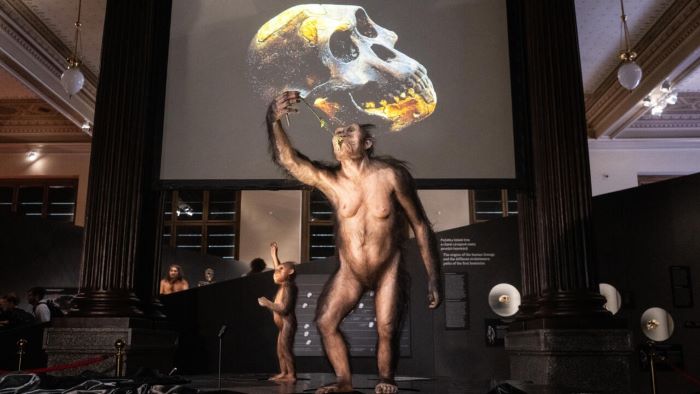
The 3.18-million-year-old bones of Australopithecus afarensis went on show at Prague’s
National Museum on Monday, where they will remain for 60 days as part of an exhibition
titled People and their Ancestors.
Unearthed in Ethiopia in 1974 by a team of scientists led by Donald Johanson, Lucy
represented the most complete early hominin skeleton ever found, with about 40% of
her skeleton is preserved. The discovery helped establish that bipedalism, walking on two
legs, developed long before larger brains, fundamentally reshaping the understanding of
how humans evolved.
Her nickname was taken from the Beatles’ song Lucy in the Sky with Diamonds, which
was playing at the archaeological dig when she was found. Since then, Lucy has
become both a scientific icon and a symbol of humanity’s deep past.
The fossils, normally kept under lock and key in Ethiopia’s National Museum in Addis
Ababa, rarely leave the country. Their arrival in Prague on 15 August was accompanied
by strict security, reflecting their immense cultural and scientific value.
At the ceremonial opening, Czech prime minister Petr Fiala hailed the occasion as
historic. “Both skeletons rank among the most precious exhibits of global heritage. They
are exhibited in a European country for the first time ever,” he said, as a military brass
band marked the occasion.
Lucy is presented alongside Selam, the remarkably preserved fossil of a three-year-old girl who lived around 100,000 years before Lucy, also discovered in Ethiopia’s Afar
region 25 years later. Sometimes referred to as “Lucy’s baby”, Selam provides insight
into how early hominins grew and developed.
For anthropologists, the pairing of the two skeletons offers a rare opportunity to present
the evolutionary story not as an abstraction but as a tangible narrative of real beings
who once lived, walked, and raised their young on the African plains. For the Czech
public, it is a chance to stand face to face with a figure who has shaped the very
understanding of what it means to be human.
Photo – The fossils lent by Ethiopia’s National Museum landed in Prague under stringent security measures © Michal Cizek / AFP