



Benelux at 65 – Free Movement Endures Amid Europe’s Border Backlash
At the Place d’Armes in Luxembourg City this week, Belgium, the Netherlands and
Luxembourg marked 65 years of free movement within the Benelux Union – a
celebration of cross-border unity taking place as much of Europe moves in the opposite
direction.
The Benelux Economic Union, established in 1958 after an earlier customs pact,
created one of the world’s first areas of seamless travel, trade and labor mobility. Its
framework allowed citizens and goods to move freely, decades before the European
Union’s single market or the Schengen Agreement. Leaders at Friday’s commemoration
called it a reminder of the benefits of integration at a time when border checks are
reappearing across the continent.
The contrast could hardly be sharper. In recent months, Germany, France, Belgium, the
Netherlands, Austria and Poland have all tightened internal borders, citing migration
pressures, irregular crossings and security risks. These moves, though legal under
Schengen rules, have prompted concern that Europe’s most visible achievement –
passport-free travel – is fraying under political pressure.
For Benelux, the anniversary offered an opportunity to show an alternative path.
Economically, the open zone has bound the three countries into a tightly integrated
market, with businesses and workers moving across borders daily. Socially, it has
nurtured a sense of shared identity, particularly in frontier regions where crossing
national lines is as ordinary as a morning commute.
The Benelux system is often described as the forerunner of Schengen, which was
signed in 1985 by the same three countries alongside France and Germany but while
Schengen is enshrined in European law and allows for the reintroduction of checks in
exceptional circumstances, Benelux has remained smaller, intergovernmental and
politically steadier. Officials see its endurance as proof that open borders can
work when underpinned by trust and long-term cooperation.
That message is pointed at a moment when governments across Europe and beyond,
are responding to migration and security fears with new walls, fences and checkpoints.
For Benelux leaders, Friday’s event was less about nostalgia than about political
symbolism, a reminder that openness is a choice, not an inevitability, and that free
movement, once dismantled, may be difficult to rebuild.
Sixty-five years on, the smallest of Europe’s unions continues to make its case – that
borders do not protect prosperity and peace, but by removing them.
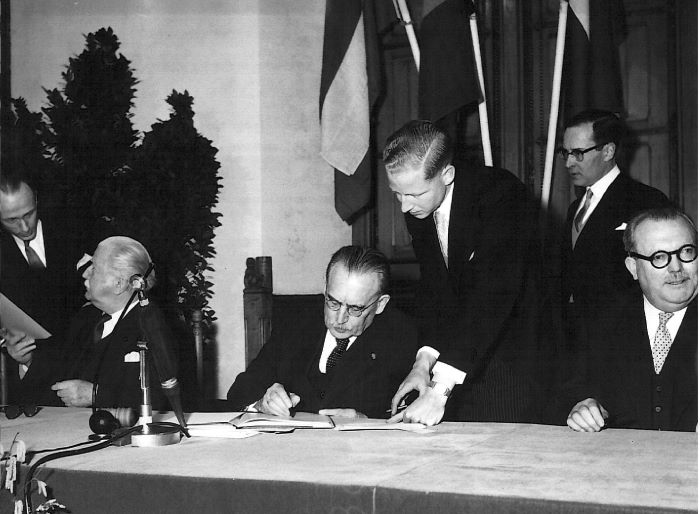
Photo – Signing of the treaty of the Economic Union of Benelux, 3 February 1958. J.Bech, Minister of Foreign Affairs of Luxembourg, W. Dries, Prime Minister of the Netherlands, and A. Van Acker, Belgian Prime Minister © PHOTO BELGA ARCHIVES