



A Dirge on Opposition Politics in Kenya
The history of opposition politics in Kenya reveals a long-shadowed tale of betrayals, sacrifice, co-option and missed opportunities. Beneath the high-profile names—Jaramogi Oginga Odinga and Raila Odinga—lies a deeper ledger of labor movement leaders, peasant insurgents, radical nationalists and grassroots militants who bore the real burden of confrontation and paid the steeper price. The Odinga father-and-son duo, celebrated in many quarters, left a legacy whose voids are striking when set beside those who fought harder, died sooner, and yet slipped into history’s margins.
Take the case of the militant labor and socialist nationalist Pio Gama Pinto, a Kenyan‐Goan journalist, activist and politician assassinated in 1965. Pinto had argued explicitly for socialism, workers’ rights and a Kenya transcending tribal or colonial identity.
He was the first Kenyan politician killed after independence, a martyr to the promise of radical change. And yet his death, as scholars note, was little more than a footnote compared to the triumphalist myths of nationalist independence. The peasant guerrillas of the Mau Mau Rebellion too deserve mention: between 1952 and 1960 thousands of men and women mostly from Kikuyu, Embu and Meru communities took up arms against British colonial rule, sought to reclaim land and freedom and built underground structures of accountability.
Their defeat was brutal: tens of thousands killed, detainees tortured, leaders executed or vanished into obscurity. Yet these insurgents at least grasped more clearly the central issue: control over land, labor, the means of production—not merely electoral turnover.
Contrast that with Jaramogi’s path of opposition. He was once a vice-president in independent Kenya, then broke away to demand multi-party politics, yet his legacy is ambivalent. While he voiced dissent against one-party rule under Jomo Kenyatta and later Daniel Arap Moi, his interventions remained bounded by the prevailing political architecture. The labor leaders, the radical union voices who may had built and sustained grassroots resistance, were sidelined. Jaramogi did not carry the struggle into deep structural transformation of land, capital or class; instead he moved on, entered different roles, accepted appointments and allowed the logic of elite accommodation to swallow the radical edge.
Raila inherited the mantle and built mass appeal, became the symbol of opposition for decades. But the fault lines remained. His message rarely articulated alternative economic formations, or a redistribution of productive assets, or a structural break with Neo-colonial linkages. Instead, the rhetoric centered on “good governance”, “anti-corruption”, “change”, all admirable but shallow when compared to the demands of class struggle or national ownership of resources.
The labor movement, which once provided backbone to Jaramogi’s oppositional efforts, found a political leadership that accommodated rather than embodied their radical energy. In many cases those union militants and social activists who might have forged a deeper insurgency ended up co-opted, marginalized or sidelined as the Odinga machine consolidated its media terrain and electoral networks.
The betrayal lies not just in the co-option but in the failure to carry forward the most combative currents of opposition. Labor federations that challenged colonial-era land claims and wage suppression, horrified by repression during the emergency, saw the post-independence state co-opt former enemies even while retaining structural continuity.
The skeptical assumption that the Odingas would carry that torch of change proved faulty. The Mau Mau fighters and their rural kin who lost lives for “land and freedom” were never the center of state narratives; instead, the state merely absorbed an elite politics that offered respectability but not redistribution. The Odingas came to serve as institutionalized opposition within a system built on colonial property regimes and Neo-liberal capture rather than system transformation.
Today the generational rupture is evident. The so-called Gen Z political activists in Kenya seem cut-off from the radical currents of the past. Their mobilizations, while dynamic, lack ideological coherence. Their message mirrors precisely what Raila’s campaigns offered: non-corruption, leadership renewal. But non-corruption is not a platform for societal change when the question is who controls the means of production, who appropriates land, who structures the economy. The Mau Mau understood this. Pinto understood this. The labor union radicals understood this. The Odingas—father and son—did not act on it fully. The Gen Z movement largely misses it entirely.
Because the Odingas became the face of opposition yet perpetuated the system of elite brokerage, the ideological vacuum for young activists is deep. They are skilled at protest but weak on structural alternatives. Consequently, they are far easier to manage, to be deflected, to be co-opted or ignored. Opposition becomes ritual rather than revolution. The neglect of labor movement militancy, the sidelining of peasant insurgency memory and the accommodation of elite politics all contribute to this vacuum.
In sum, the betrayal is two-fold: first, the abandonment or subsumption of radical labor and peasant movements that bore the real struggle; second, the transformation of the Odinga legacy into an opposition franchise that validated the system it purported to challenge. The Mau Mau soldiers died, the labor radicals were muzzled, Pinto assassinated.
The Odingas remained.
One might say they survived the system rather than overthrew it. And now, as new Kenyan youth fumble for a vision, the failure of the previous generation to build an ideological foundation looms large. The struggle was never simply about corruption or leadership. It was—and remains—about land ownership, who controls the factories, access to credit, resource control and appropriation. Until that is confronted, the betrayals of the past will continue to shape the impotence of the present.
The life and death of Raila Odinga symbolises both a political epoch and its end. Looking back at the long stretch of Odinga politics one sees a mirror of Kenyan opposition: steadfast in opposition, weak in transformation. If Kenya is to recover its promise, the next chapter must transcend the legacy of moderate dissent and craft a bold alternative. Otherwise this passing may indeed echo as a dirge for opposition politics rather than an elegy for progress.
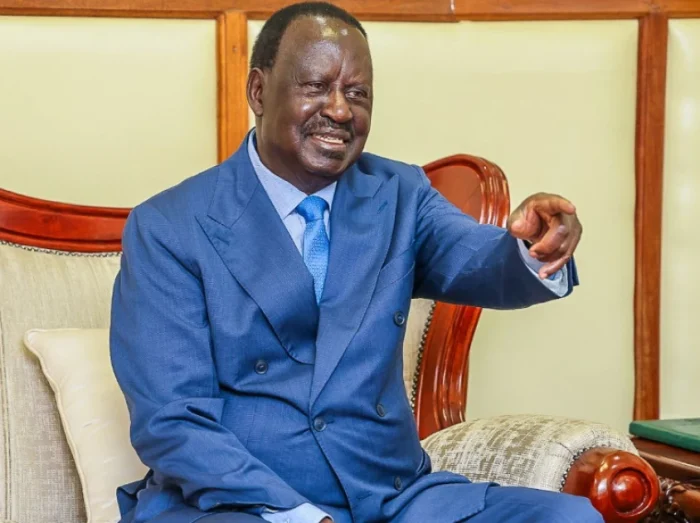
Photo – Raila Odinga
By David Danisa