








Immigration – Luxembourg’s Quiet Lifeline
Luxembourg’s prosperity has long been treated as an inevitable fact of European life – a tiny nation with outsize wealth, stable politics, and a humming financial sector that rarely falters. But beneath the polished statistics lies a truth the country has always known, even if others overlook it – immigration is the engine that keeps Luxembourg running. And as Europe tightens its borders in the name of security, electoral politics, and cultural anxiety, the Grand Duchy may soon feel the pressure more sharply than most.
Luxembourg’s economy depends not just on immigrants, but on an extraordinary influx of foreign labour. Nearly half of the country’s population is made up of foreign nationals. Add the more than 200,000 cross-border workers who pour in from France, Belgium, and Germany every weekday, and you have a labour market that is more international than domestic. Without this external workforce, Luxembourg’s gleaming towers, banks, tech hubs, and public services would grind to a halt.
The reason is simple – Luxembourg is too small to supply the labour it needs. Its booming financial industry demands specialized skills, while its hospitals, construction sites, restaurants, and care homes rely heavily on workers from abroad to fill gaps locals cannot meet alone. Immigrants and cross-border workers are the backbone of nearly every sector—often invisible, always indispensable.
Yet the country now sits at an uneasy crossroads. Rising anti-immigration sentiment across Europe, coupled with stricter border controls and tightening residency rules, threatens the free flow of labour Luxembourg has built its economic model on. Neighbouring France and Belgium have been debating tougher migration policies; Germany is revisiting its own system under political pressure. If mobility slows or access to foreign workers becomes more difficult, Luxembourg’s labour shortages – already growing in fields like healthcare, engineering, and IT, could tip into crisis.
For employers, the warning signs are flashing. Companies report difficulty filling vacancies. The construction sector warns of delayed projects. Hospitals depend on foreign nurses and doctors whose availability is now linked to decisions made beyond Luxembourg’s borders. Even the service sector, cafés, childcare, home care, relies on immigrants whose presence makes daily life in the Grand Duchy functional.
Economists argue that without immigration, Luxembourg’s welfare state itself becomes unsustainable. The country’s generous pensions and social protections depend on a large, active workforce paying into the system. A reduced foreign labour force would shrink contributions, strain public finances, and force hard political choices few Luxembourgers want to contemplate.
The economic risk is only part of the story. Luxembourg’s cosmopolitan character, its multilingual schools, its cultural vibrancy, its global mindset, comes directly from the diversity of its people. The country is a rare European experiment where dozens of nationalities coexist not in conflict but in routine collaboration. To tighten borders is not just to limit workers – it is to risk dulling one of Luxembourg’s defining competitive advantages, its openness.
As Europe debates immigration with increasing suspicion, Luxembourg faces a decision that may shape its future for decades. It can push back against the continental trend, sharpening its message that immigrants are not a burden but the lifeblood of its prosperity. Or it can allow its workforce and its economic resilience, to shrink under policies it does not control.
In a continent wrestling with demographic decline, aging populations, and shrinking labour pools, Luxembourg’s reliance on immigration is not a weakness. It is a model of adaptation. And without it, the Grand Duchy’s golden engine may run slower than anyone expects.
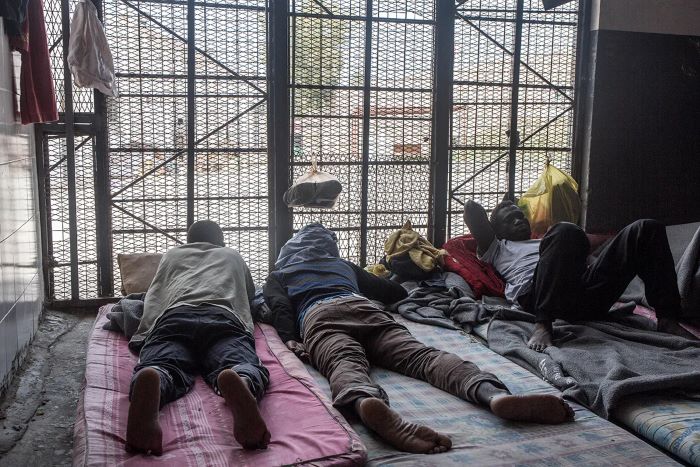
Photo – Migrants from Senegal look out into the prison courtyard from their overcrowded jail cell in the Abu Salim detention center (Financial Times)