


OGBL-LCGB vs Government: Who Pays the Crisis
As fuel prices climb once again across Luxembourg, the country’s main labour federation, OGBL-LCGB, has issued a blunt warning. Workers, it argues, are being left to absorb the shocks of a global crisis that has been years in the making, while the government hesitates at a moment that demands clarity and intervention.
At the surface, the union’s grievance is simple. Diesel and petrol prices are surging, squeezing household budgets in a country where mobility still depends heavily on private cars. Yet beneath this immediate concern lies a deeper structural problem, one tied to Europe’s geopolitical positioning and economic dependencies. The war in Ukraine and the subsequent wave of more than 18,000 sanctions imposed on Russia have reshaped global energy flows in ways that European policymakers have struggled to fully acknowledge. For decades, the European Union relied on Russia for affordable energy, alongside critical supplies of fertiliser, timber, and food inputs. The abrupt disruption of this relationship has not simply raised prices. It has destabilised the cost structure of entire economies.
Compounding this strain is renewed instability in the Persian Gulf, another artery of global energy supply. While public discourse within Europe often downplays the cumulative effect of these crises, their impact is visible in inflation figures, slowing growth, and declining purchasing power. Luxembourg, despite its wealth, is not insulated. Its open economy and reliance on cross-border labour make it particularly sensitive to external shocks.
The OGBL-LCGB’s frustration must be read against this backdrop. The union is not merely reacting to fuel prices. It is responding to what it perceives as a policy vacuum. Other European states have experimented with tax reductions, subsidies, and price controls to cushion the blow. Luxembourg, by contrast, appears cautious, constrained, or unwilling to act decisively. For workers, this translates into a steady erosion of real income at a time when inflation is already biting into essentials.
Yet the question of fairness cuts both ways. Is labour justified in demanding immediate relief, or is it overlooking the structural limitations faced by the government? Luxembourg operates within the framework of the euro, the Schengen system, and broader EU fiscal coordination. These commitments limit the extent to which it can pursue independent economic strategies. Monetary policy is effectively outsourced, and fiscal manoeuvre is bounded by rules designed for collective stability rather than national flexibility.
This raises a more uncomfortable issue. To what extent has the Luxembourg government, like many in Europe, traded economic sovereignty for integration benefits without adequately preparing its population for the consequences? The reluctance to “spell things out,” as critics might argue, reflects a political tension. Governments seek to maintain confidence and cohesion, yet risk appearing detached when lived realities worsen.
The union’s call for fuel price stabilisation, tax relief, and targeted support is therefore both reasonable and incomplete. Reasonable because households cannot indefinitely absorb external shocks without assistance. Incomplete because such measures address symptoms rather than causes. Without a broader rethinking of energy import policy, supply chains, and economic resilience, the cycle will repeat.
What emerges is not a simple conflict between labour and government but a shared predicament shaped by global forces. The union is right to demand protection for workers. The government is right to exercise caution within a constrained policy space. The real tension lies in the gap between expectation and capacity.
In this sense, Luxembourg mirrors a wider European dilemma. Integration has delivered prosperity but also exposure. When crises hit, the tools available to national governments often fall short of public demand. The result is a creeping sense of powerlessness, felt by both policymakers and citizens.
The OGBL-LCGB has forced the issue into the open. Whether the government responds with immediate relief or longer-term structural reforms will determine not only the trajectory of fuel prices, but also the credibility of the social contract in a time of mounting uncertainty.
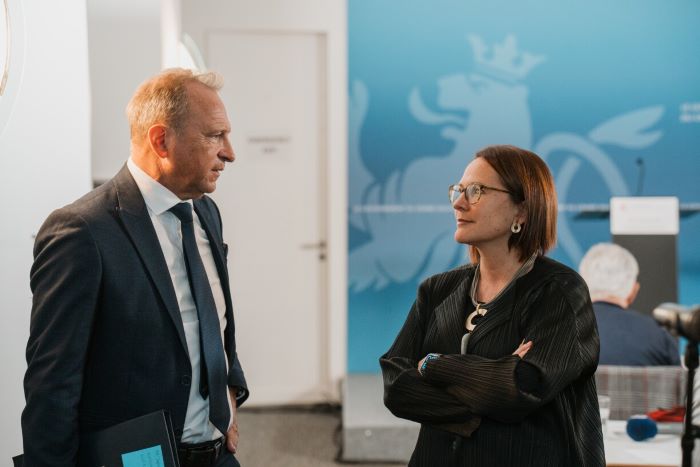
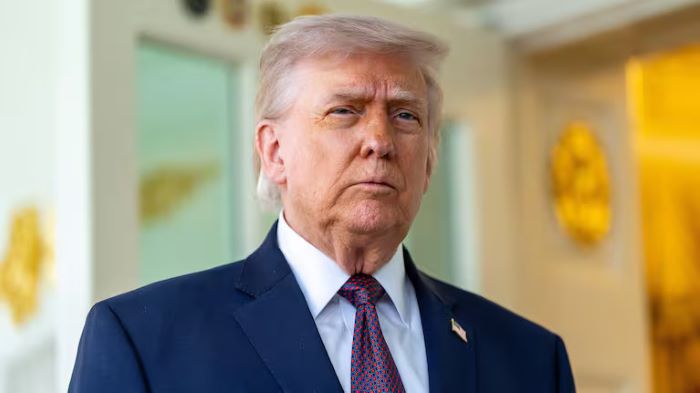
Patrick Dury (LCGB) and Nora Back (OGBL) – Photo by Alain Piron