









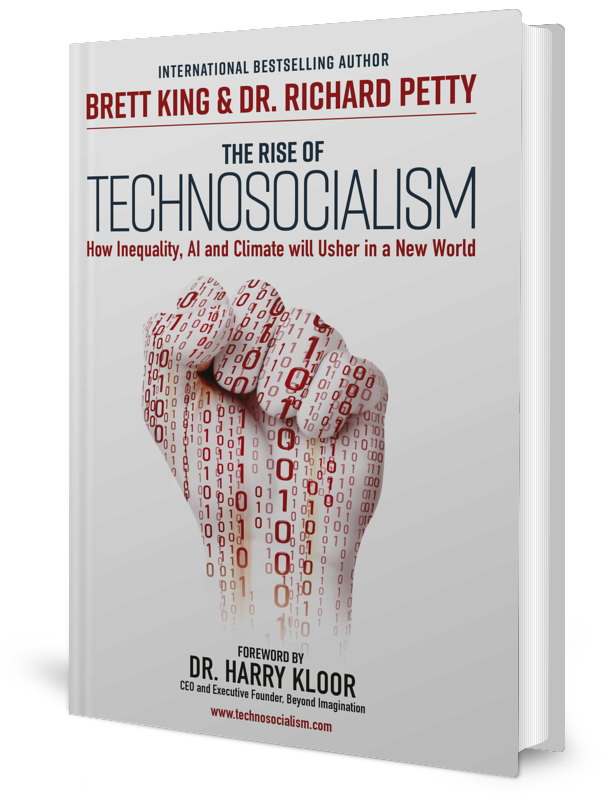
The Rise of Technosocialism
Technosocialism shines its spotlight on challenges posed by a headlong rush to automate economic production without clear-cut social policy guidelines. It achieves its mission by emphasizing undesired changes likely to occur in relations between labor and production when the process of integrating Artificial Intelligence (AI) into the production process is haphazard. This isn’t all. The book by the respected banker, author, and futurist Brett King, probes for a way out of the existentialist threat AI poses to employment and social well-being of society. It recommends a set of solutions that may transform some of these problems into “benefits”.
For King, challenges posed by AI are real. These problems would not resolve themselves or simply “go away”. Human intervention is required. At the core of the problem lies the logical deduction that with “Artificial Intelligence and Robotics and Automation we can automate so many jobs that currently “ are human processes”.
For example, “delivery robots delivering your pizza, groceries and all of that, what happens to those people that previously did that work? Same with factory workers, same with taxi drivers, you know truck drivers. In the United States of America, there are about two million transcontinental truck drivers that drive from east to west of the United States. They will probably lose their jobs within the next ten years because of autonomous vehicles. This is a challenge that must be confronted on a societal level“.
And it is not that the picture painted is that of a distant reality, oh no. According to King, the stage for confronting the future or giving in to despair is ready. AI and complications envisaged will not come on their own out of an alien world one day. Humanity set so many things in motion towards an inevitable AI take-over.
How?
“Technology is more and more profitable. So tech companies will grow bigger and stronger profitable. What they won’t do is create jobs as the older economy did. In an AI world, as demand increases, there will be less labor participation to meet that demand. All that would be required is more processing cycles”.
Thus, a world of so many inequalities and a global economy driven by supply forces more focused on profiteering compel demand is one of unbridled and every burgeoning inequality between the haves and have-nots. For organized labor everywhere, the future suggested here is daunting, if not entirely hopeless. Technosocialism presents a liberating perspective, nevertheless. Setting off from a a point of view that seem essentially Keynesian, King suggests a policy channel of reflating economy, stimulating employment, consumption growth and economic cohesion via regulatory policies and investment in the education and social sectors of the economy. He summed up the challenge and consequences of AI take-over of economy, and recommends ways they might be mitigated. He ends his projection not in despair, but an announcement of opportunities the new order presents.
Thus, declares Brett King, “in a world where technology enables you to provide that support for citizens at very low cost, socialism shouldn’t have that negative connotation it had in the past. Because the cost of providing more to the people is lower because technology enables you to do this”.
If anyone is intrigued by the line of thinking behind the choice of the title Technosocialism. King’s explanation is compelling. “Yeah, Technoscocialism, socialism is such a dirty word, in the United States right now, like say you’re a communist”, he says. “But around the world, trillion dollars technology companies with AI and robotic solutions will ultimately disrupt employment, if left alone. While AI will create new jobs, they’re gonna destroy more jobs, and at a faster rate. This forces you to implement more socialist-style policies, tied to how to mitigate risks this poses to the wider population. This was the thinking”.
Interview – “Technosocialism”, fending off AI takeover
Earthshaking changes about to affect life on earth as we know it
(Full interview)
CityNews
Your latest book, Technosocialism, why this title?
Brett
Yeah, Technoscocialism. Socialism is such a dirty word in the United States right now. In certain contexts, it means you are communist when presented as a socialist. If you look at things, you’d find out that the top 5 companies in the US right now are tech companies. And 4 out of 5 in China are technology companies. So around the world, you have more and more of these trillion dollars technology companies. Huawei, Apple, Amazon, etc. Apple has hundreds of billion cash reserves. As the tech products and solutions are more visible and prominent across value chains of business processes, these companies will more and grow bigger, stronger, and richer. The more so, the more they invest in automated processes to cut costs and increase process, to the detriment of social investment and employment. Left alone, AI and robotic solutions will disrupt employment.
CityNews
How?
Brett
Supply and demand curve, you know Adam Smith, Economics 101. The principle was, as demand increases, you will increase supply through labor participation to meet that demand. But you don’t need labor participation to increase supply in an AI world, or technology-based world, because of software. You just need more processing cycles. So that is the challenge that we are moving into.
CityNews
How would you rate the involvement of tech companies in all these?
Brett
Technology companies capture more and more wealth, more and more cash, but at the same time potentially destroy employment, while AI will create new jobs, I don’t think it will create jobs at the same rate it destroys them. Then you have technology-based unemployment you have to deal with. And so this forces you to implement a more socialist style of policies. So this was the thinking.
CityNews
Policies of what nature?
Brett
Policies designed to address such questions as to how do we mitigate the risks posed to the well-being of the greater population at large, with the implementation of AI technology while it creates large-scale unemployment. What do we do? Create job programs, rebuild infrastructure, create job programs related to climate change, and geo-engineer the planet. Maybe we will have universal basic income for basic services, free health care, free education. Traditionally, this is what we call socialist policies. But in a world where technology enables you to provide that support for citizens at a very low cost, socialism shouldn’t have the negative connotation it had in the past. The cost of providing more to the people is much lower today. After all, technology will enable us to do this.
CityNews
Perhaps this was what was missing in Marxism?
Brett
Oh, Marxism, you know I read a bit of Marxism in preparation for this book. I do think we arrived here in a very different vehicle. Which is disruption of employment and disruption of ways we earn a living. Yes, Marxism is more about more equitable distribution. But technology, as we know of it today, is slightly a proposition of another kind. Technology has the potential to create a lot more inequality if we don’t deal with this. So there are synergies here, but I do think, as a futurist and as an optimist, that technology can provide a lot of the answers.
CityNews
By liberalizing access to it and its benefits?
Brett
So to speak. For example, if you’re going to have an economy that will adapt to this future, you have to invest in different skills. Investing in truck drivers and factory workers is not going to get you there. You have to invest in STEM (Science and Technology, Engineering and Math). By providing people with access to the right skills moving forward. If I was in the US right now, instead of what they have in the education system, I will say why not make technology courses free for everyone? It should be made broadly accessible and get everyone on the card. Because this is how you build a robust economy, an economy that will survive this transition. If you’re doubling down on coal and the old industries, that just puts off the problem.