





“An Artist’s Journey”, with Rom Lammar
Exploring the Mind and Work of a Luxembourg-based Artist
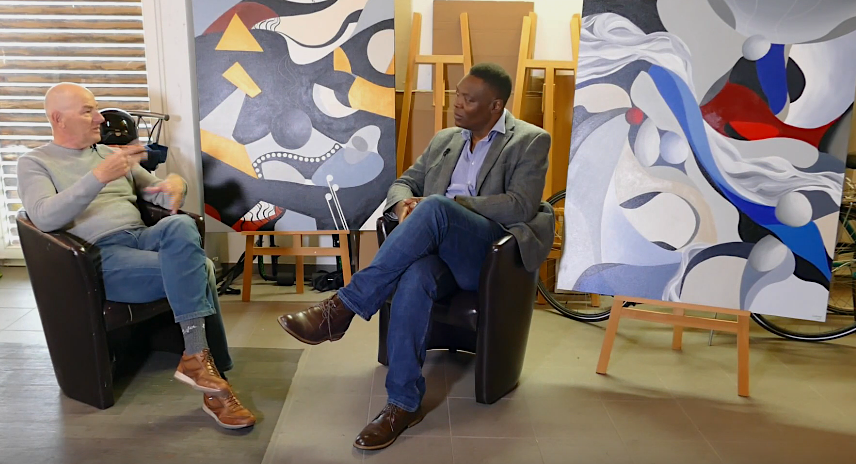
Nestled in the picturesque Moselle region of Luxembourg, Wormeldange serves as both home and inspiration for Rom Lammar, an artist whose work has graced galleries across Luxembourg and abroad. A retired geography teacher, Lammar has spent more than three decades blending his passion for travel, nature, and art. Today, his work is as much a personal journey as a professional one, defined by a constant evolution of style and technique. CityNews sat down with Lammar to discuss his artistic process, challenges in the art world, and how he views the intersection of art and society.
Though Rom Lammar didn’t pursue art professionally until his 50s, his life and career as a geography teacher laid the groundwork for his artistic sensibilities. Lammar speaks fondly of his years teaching geography, which allowed him to travel extensively. “I’ve always loved traveling,” he says, “and as a geography teacher, it was almost a necessity to explore the world.” His travels took him to art galleries and museums, where he saw firsthand the transformative power of art in shaping perspectives.
Lammar’s initial foray into art was modest, with small watercolors of Luxembourg’s cityscapes. These early works were a personal hobby, but they soon caught the attention of local galleries. “It was because of the Galerie Saint-Michel that I gained confidence in my work,” he recalls. This first boost led to a successful solo exhibition in 1988, where Lammar sold nearly all of his paintings. This success marked the beginning of his artistic journey, but as he soon discovered, the path wasn’t always linear.
Art as Evolution: Shifting Techniques and Styles
As Lammar’s career progressed, so too did his artistic expression. His early works, often inspired by nature, gradually gave way to more abstract compositions. “After painting the city of Luxembourg a hundred times, I became bored. I needed something more,” he admits. Lammar’s transformation wasn’t just about abandoning old subjects; it was also about exploring new techniques. His work began to reflect his changing interests, moving from the delicate watercolors of Luxembourg’s cityscapes to bolder geometric forms, each painting an experiment in color and composition.
For Lammar, technique is driven by the subject at hand. “When I change my style, my technique changes too,” he explains. His geometric works, characterized by sharp lines and vibrant colors, demand precision. “If I create a circle and go beyond the lines, I have to correct it. It’s meticulous.” In contrast, his chiaroscuro pieces require spontaneity. “It’s much freer, much more instinctive,” he says, referring to the use of light and shadow in his paintings. Whether using brushes, spatulas, or sponges, Lammar experiments with different tools and materials to achieve his desired effects, always seeking new ways to push his creative boundaries.
Lammar’s artistic intuition plays a pivotal role in his creative process. “When I make an abstract composition, I see it intuitively—whether it’s balanced, harmonious, whether the colors work together or not,” he notes. “I can’t really explain it, but when it feels right, I leave it. If it’s not right, I correct it.” This intuitive approach to art, coupled with an understanding of classical composition rules like the golden ratio, gives his works a timeless quality.
While Lammar’s professional life was rooted in education, he believes art should be accessible to everyone, regardless of their background or formal training. “You don’t need to study art to express yourself. Everyone can enjoy art, whether or not they have knowledge of it,” he asserts. “Art is about communication, and anyone should be able to participate in that conversation, both as a viewer and as a creator.”
Lammar is also keen to emphasize the role of life experience in shaping an artist’s vision. “It’s not just about technique or what you’re taught in art school. It’s about what you’ve lived, the places you’ve been, the people you’ve met,” he says. For Lammar, art is a reflection of the artist’s unique perspective, and that perspective is shaped by a lifetime of personal experiences, not just formal training.
Despite Luxembourg’s reputation for wealth and prosperity, Lammar acknowledges that living as a full-time artist in the country is a challenge. “It’s very difficult to live off art in Luxembourg,” he admits. “There are very few who can do it professionally. Even though Luxembourg is a rich country, the art market is quite saturated.” Lammar suggests that while the country is filled with amateur artists and hobbyists, the market for professional art remains small.
This saturation, he argues, stems from the prevalence of hobbyists who often exhibit their works in the same spaces as more established artists. “There are many exhibitions, but the market is crowded. It’s hard to make a name for yourself,” Lammar says. Yet despite these challenges, he finds solace in the ability to curate his own exhibitions. “I prefer to organize my own shows rather than rely on galleries. I’ve had mixed experiences with galleries, and sometimes, they’re not as honest or as kind as I would hope.”
One of the most striking aspects of Lammar’s work is his approach to pricing. His paintings are affordable, with prices that reflect the hours of work invested in each piece. “I know that many people have to work long hours to earn a thousand euros,” he says. “So, I won’t charge 10,000 euros for a painting that took me 15 hours to make. I think that would be unrealistic and unreasonable.”
Lammar’s pricing philosophy is rooted in a sense of morality and fairness. “I believe in keeping art accessible. It’s about finding the right balance between the work involved and what people can afford.” This practical yet principled approach to pricing further demonstrates Lammar’s deep connection to his community and his desire to make art available to as many people as possible.
Looking ahead, Rom Lammar remains committed to his artistic journey, continually refining his craft and seeking new ways to express his ideas. Whether through the bold geometric works that now define his style or the spontaneous, evocative paintings he creates in his studio, Lammar’s art continues to captivate and inspire. For him, the true reward lies in the act of creation itself and the connections it fosters with others.
For Rom Lammar, the journey of art is never truly complete—it is a lifelong process of discovery, innovation, and, above all, passion.