








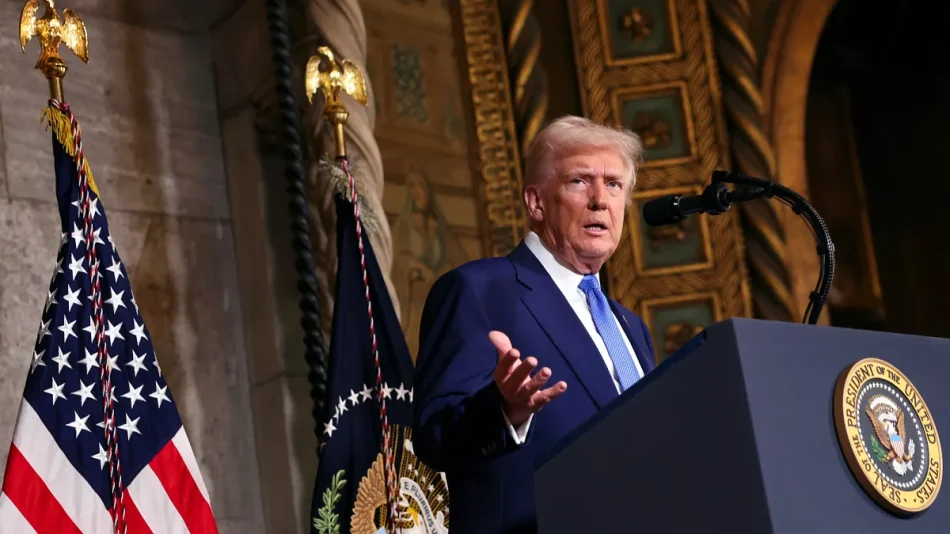
Trump’s Tariff Bomb – Can a Fractured EU Fight Back or Face a Post-Globalization Meltdown?
An investigative opinion analysis on the European Union’s fractured response to Trump’s trade war—and what it means for the future of globalization.
Luxembourg, April 7 – A storm is brewing in global trade—and at its epicenter stands President Donald Trump, wielding tariffs as his economic weapon of choice. His latest volley of protectionist measures, slapping up to 25% tariffs on EU steel, aluminum, automobiles and a sweeping 20% on nearly all other imports from the bloc, has rattled Brussels and exposed a deeply divided European Union scrambling to formulate a coherent response.
Despite calls for unity, the EU is far from aligned. As Trump re-calibrates the global trading order around American industrial revival and economic nationalism, the EU appears unprepared, both politically and institutionally, to mount a robust and unified counteroffensive. At stake is not just the EU’s trade surplus with the U.S., but its very identity in a world turning away from globalization.
An Uneasy Alliance: France Charges, Ireland Bulks. The fractures were on full display this week in Luxembourg as EU trade ministers gathered to hash out a response. France, backed by Germany and Austria, came out aggressively—calling for retaliatory action that includes targeting U.S. digital services. This would hit the soft underbelly of American dominance, “Big Tech”.
But not all member states are onboard. Ireland, which benefits massively from U.S. tech giants like Apple, Meta, and Google setting up shop in Dublin, vehemently opposed this line of attack. Irish Trade Minister Simon Harris warned against what he called “extraordinary escalation,” underscoring that any retaliation must be “calm and measured.” Italy and Spain echoed similar sentiments, urging restraint. “Avoid uncontrolled reactions,” said Italy’s Foreign Minister Antonio Tajani. Spain emphasized a non-escalatory message that “does not provoke further conflict.” This disunity begs a fundamental question. Can the EU ever present a coherent common position on U.S. tariffs—especially when national interests are so divergent?
Trump’s Tariff Doctrine, an Existential Threat to the EU’s Trade Model. Trump’s economic rationale is simple but devastating. The U.S. imports more than it exports, and he wants to reverse that. In 2023, the EU exported €532 billion worth of goods to the U.S., while importing just €334 billion. That €198 billion surplus makes the EU a prime target. The Trump administration’s response is two-pronged, reduce the U.S. trade deficit and bring manufacturing jobs home. Tariffs are the main lever. But for the EU, this is more than an economic skirmish—it’s an assault on its foundational trade logic.
While the EU does hold a surplus in goods, it has a €109 billion deficit in services, particularly dominated by U.S. firms. If Brussels retaliates against goods, Trump can escalate on services, striking where the EU is most vulnerable—pharmaceuticals, finance, and logistics. France and Germany are lobbying to invoke the Anti-Coercion Instrument (ACI), a legislative “bazooka” passed in 2023, giving the EU sweeping powers to retaliate. Options on the table include barring U.S. firms from public procurement contracts, curbing digital services access, and even suspending intellectual property protections. But that’s a nuclear option—and not all EU members are ready to push the red button.
Brussels Prefers Negotiation—but for How Long? EU Trade Commissioner Maros Sefcovic insists that the bloc prefers negotiation. A “zero-for-zero” tariff deal has been proposed to Washington, offering to scrap car and industrial product tariffs on both sides. But optimism is scarce. Trump’s team has shown little interest. His top trade adviser brushed aside Elon Musk’s call for tariff-free trade, dismissing him as a mere “assembler.” With little progress at the negotiation table, the EU’s fallback is its retaliatory list, now trimmed due to Trump’s threats. Originally, bourbon, wine, and dairy were on the list—but these were removed to avoid a counterstrike from Trump, who threatened 200% duties on EU alcoholic beverages. A narrowed set of tariffs (25%) will now hit selected U.S. imports starting April 15, with a second round in May. The question remains, will this piecemeal approach deter Trump, or would it embolden him?
The Bigger Picture, Is the EU Ready for a Post-Globalization World? The real crisis facing the EU is strategic. Trump’s tariffs are not random—they are a systemic rejection of the post-Cold War globalization order that Europe has thrived in. In its place, Trump is building a world of economic blocs, national industrial revival, and strategic decoupling.
So, is the EU prepared? Institutionally, the EU remains hamstrung. Trade policy, while led by the Commission, still requires consensus from 27 member states with vastly different economic structures and exposure to U.S. markets. Unlike the U.S., where a president can impose tariffs unilaterally, the EU must negotiate internally—often to a stalemate.
Politically, the EU faces elections in June, and no party wants to provoke a U.S. backlash that could cost jobs or exports. Smaller states fear economic blowback. Larger states like France and Germany see an opportunity for strategic assertion—but cannot move without others. Strategically, the EU lacks a plan for de-risking from American economic power. While diversification efforts have begun, particularly toward Africa and Southeast Asia, these are nascent. European companies remain heavily dependent on U.S. supply chains, finance, and tech infrastructure.
Some diplomats hope that China’s retaliation, set to hit the U.S. later this month, will trigger a reconsideration in Washington. “Wait and see” is the current mantra. But this risks painting the EU as weak and reactionary. Trump’s tariffs are already sending shock-waves through steel, automotive, and pharmaceutical sectors in Europe. If Trump is re-elected in November 2024, these measures may harden into long-term policy. That would force the EU to re-imagine its global trade relationships—not just with the U.S., but with China, India, and Africa.
In the absence of a coordinated, timely, and assertive response, the EU risks being squeezed between rival superpowers in a world where globalization is no longer the default.
An Unprepared Giant in a Changing World. The EU faces a moment of reckoning. President Trump’s aggressive tariffs are not just punitive—they are transformative. They challenge the assumptions that underpin the European project: open markets, rules-based trade, and global interdependence.
Yet the EU’s reaction remains fragmented. Internal divisions, institutional inertia, and political caution have created a vacuum where assertive strategy is needed. The longer the EU hesitates, the more it risks becoming collateral damage in a war it didn’t start—but might lose. If the bloc cannot adapt to the end of globalization as we knew it, its future as a global economic power—and as a cohesive political entity—may be in question.
Because in Trump’s world, there are no allies—only winners and losers.
By Yvan David Danisa, CITYNEWS