







EIB’s Bold Self-Appraisal Meets Reality Check
The European Investment Bank (EIB) Group’s recent self-assessment of its performance in the first half of 2025 is not short of praise, with President Nadia Calviño hailing the approved €15.5 billion in new investment as “building the future.” This assertion, embedded in superlatives, paints an image of strategic excellence and bold leadership in financing Europe’s and the world’s transition towards a sustainable, secure, and innovation-driven economy. But the question remains: does the evidence support this glowing declaration, or is the EIB grading itself too generously?
In terms of raw numbers, the €14.5 billion approved by the EIB and €1 billion by the EIF is indeed considerable. The projects span across vital sectors—transport, housing, energy, water resilience, and innovation. The geographic scope is broad, covering EU member states, South America, North Africa, and the Western Balkans. However, size is not necessarily synonymous with strategy.
When the pattern of the approved funding is examined, the projects appear diverse but not obviously cohesive. The bank’s choices—whether it is enhancing energy efficiency in Portugal, financing rail infrastructure in Estonia and Italy, or supporting housing in Portugal and Germany—seem more reactive to incoming viable proposals rather than being guided by a cohesive sectoral or regional vision.
There is no unmistakable through-line suggesting an integrated industrial ecosystem approach, whether vertical or lateral. Instead, the EIB seems to prioritize project viability on a case-by-case basis, albeit loosely framed under EU policy priorities like the green transition, energy security, and innovation.
That said, the Water Resilience Program is one of the few examples of a structured and targeted initiative. Developed in tandem with the European Commission’s Water Resilience Strategy, it aims to mobilise €40 billion globally over three years. This shows that where coordination exists, the EIB can build long-term financing frameworks tied to strategic goals. But the fact that such examples stand out as exceptions hints at a broader inconsistency in vision.

From a performance history perspective, the EIB Group’s global reputation has largely been positive. The €89 billion in financing approved in 2024 for over 900 projects reinforces its image as a high-capacity lender. The bank’s projects are bound by its Climate Bank Roadmap, aligning with the Paris Agreement, with nearly 60% of annual financing directed at climate goals.
Moreover, 50% of the EU-based funding goes to cohesion regions—areas most in need of economic reinforcement. These figures indicate strong alignment with policy mandates and high environmental and social consciousness.
Still, beneath these metrics lies a mixed track record. Studies and independent evaluations over the past five years suggest that while most EIB-funded projects reach completion, success often varies significantly depending on region and sector. Infrastructure and energy projects tend to perform better in Western and Northern Europe, while in lower-income regions, implementation is frequently delayed by local governance and administrative issues.
The average duration of an EIB project is between five to seven years from approval to full implementation. The success rate hovers around 70–75%, with delays and scope reductions being the most common causes of under-performance. Failures, although relatively rare, are instructive. One of the most high-profile setbacks involved a major urban redevelopment project in a Southern European capital, marred by cost overruns, legal disputes, and non-compliance with environmental standards. Conversely, one of the standout successes has been the EIB’s early and substantial financing for COVID-19 vaccine development through biotech investments, helping to de-risk innovation when it was most needed.
In light of the current funding round, there is merit in the EIB’s self-congratulatory tone, especially in terms of maintaining pace, aligning with EU policy, and ensuring geographic spread. But the absence of a clear, interconnected framework for investment points to a more opportunistic approach rather than one that is guided by a unified industrial or geographic vision.
Thus, while the EIB has certainly not failed in its mission, the claim of exemplary performance requires more nuance. A bank of such scale and ambition cannot afford to measure success only by the quantum of financing or the breadth of coverage. What matters equally is whether its funding choices are transforming regions and sectors in a durable, interconnected way. On that front, the EIB still has work to do.
David Danisa – CityNews
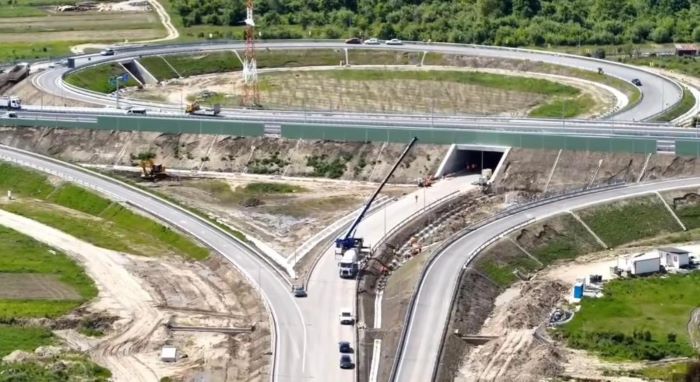
Photo – A1 Motorway, EU Cohesion Co-Financing “Better Road Connections, Romania”