








What’s at Stake as Britain and Germany Sign ‘Friendship Treaty’?
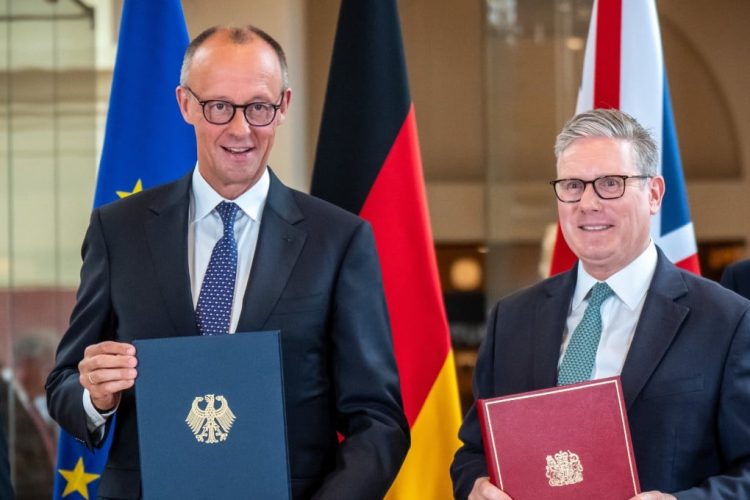
In a powerful symbol of renewed unity and shared purpose, British Prime Minister Keir
Starmer and German Chancellor Friedrich Merz today signed a landmark “Friendship
Treaty” at London’s Victoria and Albert Museum, a location chosen to reflect the
enduring ties between the two nations, exemplified by the historic union of Queen
Victoria and Prince Albert.
The 23-page treaty marks a significant moment in British-German relations, aimed at
resetting the tone after years of uncertainty and diplomatic chill following the UK’s exit
from the European Union. For both countries, the agreement signals a mutual desire to
strengthen bilateral cooperation on key issues, ranging from trade and defense to
climate action and global security.
“This is a historic day for German-British relations,” Merz said during the ceremony. “It’s
also a great honor for me personally to be here in a museum that bears the names of
two figures so central to the shared history of our nations.” His words underlined the
personal and political significance of the accord, which comes after months of behind-
the-scenes diplomatic negotiation.
For Germany, the treaty offers a crucial partnership with a major European military and
intelligence power at a time of rising geopolitical instability. With Russia’s aggression in
Eastern Europe and mounting concerns over global migration, Berlin sees deeper
cooperation with London as a strategic necessity. The treaty enables both sides to
jointly tackle these challenges, pooling resources and intelligence, and presenting a
more unified front in NATO and beyond.
For the UK, the agreement represents a cornerstone of Prime Minister Starmer’s post-
Brexit foreign policy, a clear message that Britain can be both outside the EU and a
central partner to Europe. Starmer, keen to restore Britain’s standing on the
international stage, has already hosted several European leaders in recent weeks, and
this treaty with Germany solidifies his vision of a “re-engaged” Britain, focused on
pragmatic cooperation rather than isolation.
Insiders say the personal rapport between Starmer and Merz, strengthened during a
joint trip to Kyiv with French President Emmanuel Macron, has helped fast-track the
deal. That camaraderie has now translated into concrete diplomatic progress.
The Friendship Treaty, though symbolic in name, carries tangible political weight. It is
not just a declaration of good will but a framework for deeper collaboration between two
of Europe’s most influential nations. As the continent faces an increasingly turbulent
future, the message is clear – the UK and Germany are choosing partnership over
distance.