



Trump’s Tariff Threat on India – A Sovereignty Showdown?
Donald Trump’s recent announcement to impose a 25% export tariff on India, coupled
with an unspecified “penalty” for its ongoing purchases of Russian energy and military
equipment, has sent ripples across global capitals. Posted on his social media platform,
Truth Social, Trump’s declaration cites India’s “far too high” tariffs and “strenuous and
obnoxious non-monetary Trade Barriers,” but explicitly links the new punitive measures
to India’s deepening economic and military ties with Russia. This aggressive move,
coming on the heels of similar threats to Russia’s trade partners, raises a crucial
question, is Trump now acting as a global bully, dictating how sovereign nations conduct
their foreign policy and economic affairs?
The immediate reaction from New Delhi has been cautious, with the Ministry of
Commerce and Trade stating they are “studying the implications” and will “take all steps
necessary to secure our national interest.” However, underlying this measured response
is a complex geopolitical dance and a palpable tension over national sovereignty.
Trump’s “America First” doctrine has consistently championed tariffs as a primary
leverage point in international relations. In his first term, he famously applied duties on
goods from numerous countries, including China, under the guise of addressing trade
imbalances. This latest threat against India, however, carries an additional layer of
geopolitical pressure. By explicitly penalizing India for its dealings with Russia –
particularly its energy and military purchases – Trump is attempting to weaponize trade
policy to influence India’s strategic autonomy.
India’s historical reliance on Russian military equipment stems from decades of close
ties and the reliability of supply, a factor that cannot be easily or quickly diversified.
Similarly, India’s energy needs are immense, and Russia has become a significant,
cost-effective supplier amidst global energy price volatility. From India’s perspective,
these are sovereign decisions vital to its national security and economic stability.
The concept of national sovereignty dictates that each state has the right to govern itself
without external interference. When a powerful nation like the United States, under
Trump’s leadership, threatens economic penalties to influence another country’s foreign
policy choices – particularly those related to defense and energy – it inevitably raises
questions about the erosion of this fundamental principle.
Critics argue that such actions constitute a form of “bully diplomacy.” They contend that
rather than fostering cooperation, it creates an environment of coercion, where weaker
or less influential nations are forced to align with the preferences of dominant powers or
face economic repercussions. This approach, they argue, undermines the multilateral
framework of international relations and sets a dangerous precedent for global trade
and diplomacy.
Furthermore, Trump’s previous threats to impose tariffs on Russia and its trade partners
if Moscow failed to reach a ceasefire agreement with Kyiv, and his subsequent
shortening of that deadline, illustrate a pattern of using economic pressure as a direct
means to dictate political outcomes in other sovereign states.
India’s Dilemma and the Broader Implications of the situation for India, presents a
delicate balancing act. While the US remains a crucial strategic partner, particularly in
the Indo-Pacific region, India fiercely guards its strategic autonomy. Succumbing to
external pressure on core aspects of its foreign and defense policy could set a
precedent that undermines its long-term interests and independence.
The tariffs, if fully implemented and sustained, are predicted to have a tangible impact
on India’s export-oriented sectors, including textiles, pharmaceuticals, and marine
products, potentially shaving off basis points from its GDP growth. The Indian rupee has
already shown signs of volatility in offshore markets following the announcement.
Beyond the immediate economic impact, the incident forces a reconsideration of the
global order. Does the world face an era where economic interdependence is
increasingly weaponized to enforce ideological alignments? Will nations be forced to
choose sides in geopolitical contests, even at the expense of their perceived national
interests?
As August 1 approaches, the world watches to see if Donald Trump’s latest tariff threat
is a negotiating tactic to secure a more favorable trade deal with India, a genuine
attempt to reshape global supply chains and alliances, or indeed, a bold assertion of a
“bully pulpit” that challenges the very notion of sovereign decision-making in an
interconnected world. The answer will have profound implications for international law,
trade relations, and the future of global power dynamics.
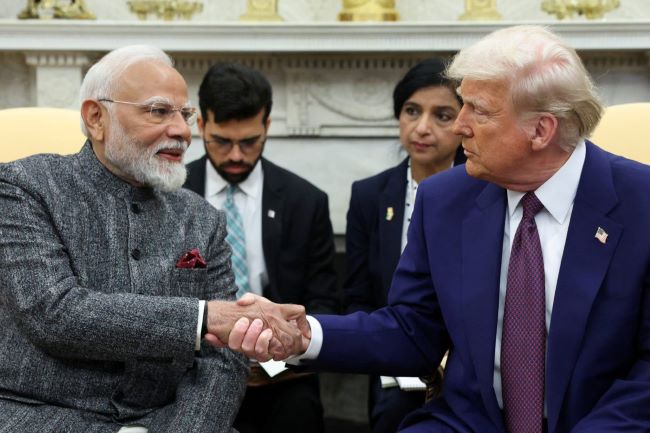
Photo – U.S. President Donald Trump and Indian Prime Minister Narendra Modi shake hands, at the White House in Washington, D.C., U.S., February 13, 2025. Photo by Kevin Lamarque/File Photo for Reuters