








The Procession to Golgotha
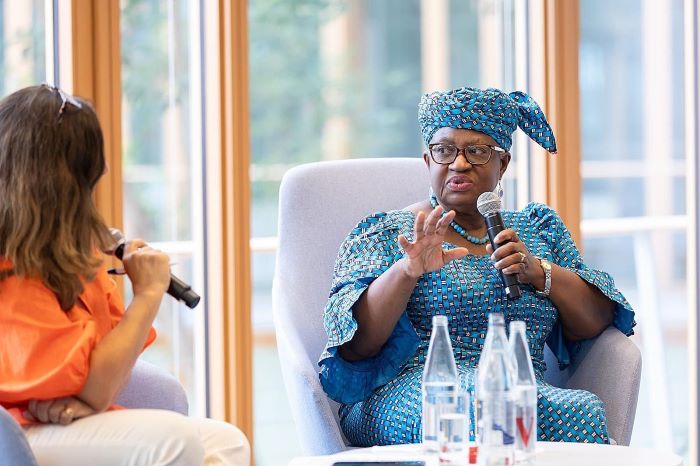
Dr. Ngozi Okonjo-Iweala’s appearance at the European Investment Bank in Luxembourg was staged as a reaffirmation of multilateral faith. Yet the choreography exposed not renewal but a ritual procession that revealed the hollowness of the very system she presides over. For all the optimism in her exchanges with Nadia Calviño, the reality is that the WTO has been displaced from the center of gravity in global trade. That displacement is not accidental. It has been engineered most dramatically by the phenomenon of Donald Trump, who as President of the United States effectively rewrote the rules of world trade without acknowledging the relevance of the WTO or its codes.
Trump’s project, often derided as reckless unilateralism, should instead be understood as a deliberate strategy for the survival of the collective West. The United States became the hub of postwar trade by assuming the role of guarantor and arbiter of economic flows. Through the Bretton Woods framework, through GATT and later the WTO, through institutions designed to safeguard Western preeminence, Washington dictated the structure of markets. Most Favored Nation status was not a neutral legal instrument. It was a geopolitical tool, conferred upon strategic actors whose alignment served American security and economic primacy. In Europe, in East Asia, across parts of Latin America, MFN became a means of binding partners into an orbit underwritten by American power.
This order persisted so long as Washington remained unrivaled. The arrival of China as an economic superpower has upended that logic. Today close to eighty percent of the world counts China as its major trading partner. This reality makes the old MFN architecture look not only outdated but irrelevant. Trade concessions that once anchored loyalty no longer suffice when Beijing offers larger markets, deeper supply chains, and fewer political conditions. The United States finds its instruments blunted. Trump’s response was not incoherence but an admission that the multilateral order no longer served its originators. Tariffs, selective deals, outright threats, and a dismissal of WTO rulings all formed a strategy to free Washington from rules that constrained it more than its rivals.
What Okonjo-Iweala confronted in Luxembourg was not just a skeptical audience but a shifting world where the WTO cannot compel obedience. The silence of European leaders in the face of Washington’s trade diktats illustrates the point. Ursula von der Leyen’s inability to check American protectionism, even when it damaged European industries, showed how little leverage Brussels possessed. The WTO’s voice in such matters is almost spectral, heard but without power. That is why the EIB’s invitation, for all its symbolism, risked becoming a séance where the faithful pretended the institution still commanded relevance.
The more telling counter-force comes not from Europe or other Western actors but from what is increasingly called the global majority. States in Asia, Africa, and Latin America have refused to be herded into the unipolar script. They do not confront Trumpism with speeches about rules. They oppose it by building alternative arrangements, by diversifying trade and finance, by ignoring the moral authority that Western institutions once claimed. Their resistance is pragmatic rather than rhetorical. It lies in pursuing ties with China, in forming regional trade blocs, in constructing payment systems and infrastructure projects that circumvent Western leverage.
Trumpism, then, is not merely the caprice of a populist leader. It represents the West’s recognition that the instruments it created after 1945 cannot secure its dominance in a multipolar age. The use of tariffs, sanctions, and financial coercion is an attempt to enforce one destiny for the OECD world, to rally its members under American leadership, and to demand greater sacrifices from allies in the name of survival. In this sense Trumpism is the logical outgrowth of the very order that institutions like the WTO were meant to sustain.
Dr. Okonjo-Iweala’s task at the EIB was unenviable. She was asked to reaffirm belief in a system whose foundations have cracked. Her words about peace, prosperity, and resilience through trade sound noble, yet they hover over an abyss. The global majority is no longer invested in preserving unipolarism. The United States has abandoned multilateral constraint when it finds it inconvenient. Europe lacks the will to resist. What remains are rituals of affirmation, elegant stages where officials recite the language of multilateralism even as the world walks away.
The procession continues, yet it is not toward renewal. The light once promised by universal rules has dimmed, and the actors now march toward a different destination. The gathering in Luxembourg, for all its civility, resembled not a summit of ideas but a procession to Golgotha.
David Danisa