








Scientists Edge Closer to Making Human Eggs From Skin Cells
Scientists have inched closer to a breakthrough that could one day allow human eggs to
be created from ordinary skin cells, raising both scientific hopes and ethical questions.
In a study published this week in Nature Communications, researchers combined
cloning techniques with fertilisation and chemical triggers to coax human skin cells into
producing eggs. Some of those eggs, when fertilised, were able to develop into early
human embryos, though none survived beyond six days and all contained abnormal
sets of chromosomes.
The process marks the latest effort in a field known as in vitro gametogenesis – the
creation of eggs and sperm from other human cells. Scientists have already achieved
the feat in animals, including mice and even giant pandas, but attempts in humans have
repeatedly stumbled.
In the new study, the reprogrammed skin cells failed to shed half their chromosomes as
healthy eggs normally would. To prompt that step, researchers added a compound
called roscovitine, which partially triggered the process. While some embryos formed,
many carried the wrong number of chromosomes – one embryo, for instance, had 48
instead of the normal 46, with entire chromosomes missing or duplicated.
Researchers believe the uneven divisions occurred because chromosomes paired
randomly rather than matching with their proper counterparts. “It was not the outcome
we wanted, but it shows the process can now be set in motion,” said study author
Alessia Amato, who cautioned that clinical applications remain at least a decade away.
None of the embryos were permitted to develop past the blastocyst stage, in keeping
with international guidelines. Human embryo research faces strict legal limits,
particularly in the United States, where genetic modification of embryos is prohibited.
The approach also carries technical hurdles. It currently requires donor eggs for the
initial cloning step – a limitation that rivals in the field, such as Japanese researcher
Katsuhiko Hayashi, are trying to overcome through alternative reprogramming methods.
Still, Hayashi described the study as a “significant breakthrough” in demonstrating that
the human genome can be halved artificially, a key step toward viable egg creation.
While viable embryos remain a distant prospect, scientists say the research could
eventually transform fertility treatment, offering new possibilities for people unable to
produce eggs naturally. For now, it remains a proof of concept, a fragile demonstration
that the blueprint for life can, at least in part, be redrawn from skin.
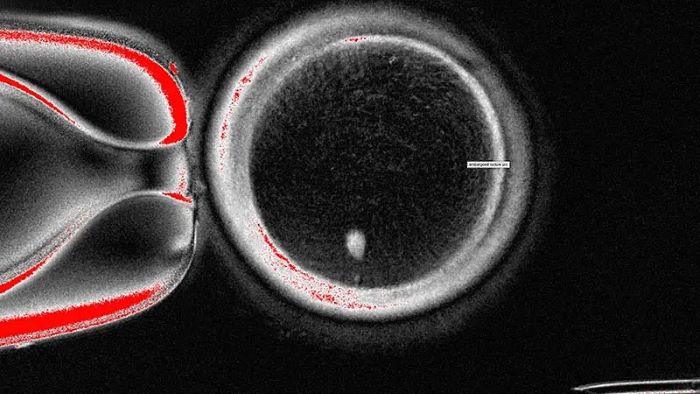
Photo – This undated image provided by the Mitalipov Laboratory at Oregon Health & Science University shows a a microscope image of a human egg that contains a nucleus taken from a skin cell. (Mitalipov Laboratory via AP)