






Quantum Sensing – Luxembourg Converting Next-Generation Science Into National Economic Muscle
Luxembourg’s ambition to stay on the frontier of space technology deepened this week as the Luxembourg Space Agency awarded a research contract to the Canadian Space Mining Corporation (CSMC) to advance quantum sensing for planetary and terrestrial resource exploration. The decision marks another step in the Grand Duchy’s long-term bid to convert next-generation science into national economic muscle, even as questions linger about how quickly such bets will pay off.
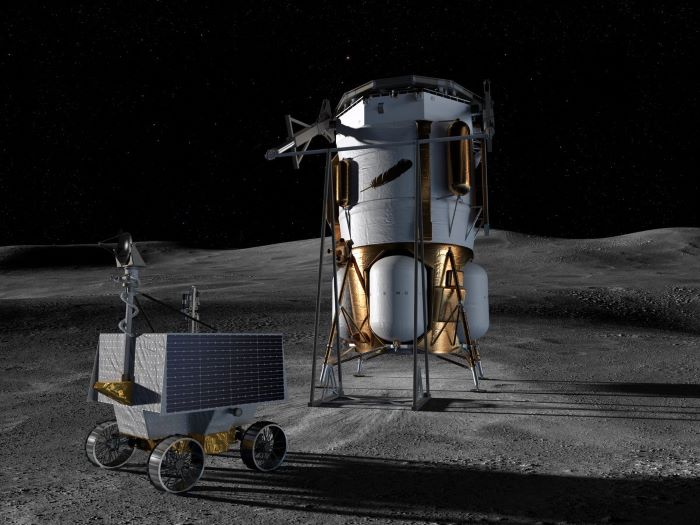
Quantum sensing, once the domain of delicate laboratory experiments, is fast becoming a tool with sweeping commercial implications. The technique relies on the strange rules of quantum mechanics, using ultra-cold atoms and exquisitely sensitive interferometers to detect minute variations in gravity. On Earth, those variations often signal changes in underground density – the subtle signatures of aquifers, mineral deposits, voids or buried geological structures. In space, similar instruments could help locate resources like water ice or volatiles on the Moon, Mars or asteroids. By pushing these sensors into orbit, researchers hope to build high-resolution maps of what lies beneath a planet’s surface without drilling, blasting or sending large teams into the field.
For Luxembourg, that kind of capability is more than a scientific curiosity. The country has spent nearly a decade shaping a niche identity around space-resource exploration, data services and deep-tech innovation. A satellite-borne quantum gravimeter fits squarely into that strategy – a tool that could create exportable data products, attract high-value companies and plant Luxembourg’s flag early in technologies that larger countries have been slower to prioritise. CSMC’s proposal, which combines Earth-focused applications with preparations for future off-world prospecting, aligned neatly with Luxembourg’s own push to pair immediate economic usefulness with longer-term space-resources ambitions.
Officials close to the project argue that the payoffs will come in layers. The contract itself generates work for engineers, analysts and software developers, strengthening a domestic ecosystem that the government has spent years cultivating. The downstream potential is even broader – if the technology matures, Luxembourg could host companies that process, sell and interpret the gravimetric data, creating a supply chain of analytics and geospatial services with global demand. Quantum instruments also tend to spill over into other sectors – navigation, civil engineering, climate modelling – creating scientific know-how that can be repurposed far beyond the mining industry.
Still, the bet carries risk. Quantum systems are notoriously fragile, and building a sensor that can withstand the cold, vibration and radiation of orbit is a formidable engineering task. The commercial market for satellite-based gravity mapping remains young, and traditional ground surveys are cheaper in many regions. Critics of Luxembourg’s innovation-heavy strategy often point out that the government is funding long-horizon projects at a time when the country is still grappling with pressures in housing, healthcare and transport.
Yet judged against Luxembourg’s broader trajectory, the investment is consistent. Measured relative to the size of its economy, the country spends more on space activity than any of its neighbours, including France and Germany. That intensity, not absolute budget, is what has allowed Luxembourg to punch above its weight in attracting aerospace firms and research labs. While bigger states distribute their budgets across defence, aviation and satellite manufacturing, Luxembourg concentrates its resources on a few high-value niches. The result is an ecosystem that is small but unusually advanced, supported by fast regulation and a willingness to take bets on early-stage technology.
Whether quantum sensing will be one of the success stories remains to be seen. Early prototypes could take years to refine, and commercial services even longer to scale. But for Luxembourg’s policymakers, the logic is familiar – small countries cannot compete by waiting for certainty. They compete by moving first. In partnering with CSMC, Luxembourg is wagering that the next frontier of resource exploration – on Earth and eventually in space, will belong to those who master the ability to see what others cannot.