







From Manure to Megawatts – How Britain Is Turning Cow Dung into Power
Across the British countryside, in places long associated with milk churns and muddy boots rather than energy policy, cow dung is being reimagined as a strategic national resource. In an era of volatile gas markets, climate targets and uneasy geopolitics, the UK is quietly building a network of biomethane plants that transform livestock waste into heat and power for millions of homes, reshaping the idea of where energy can come from and who can produce it.
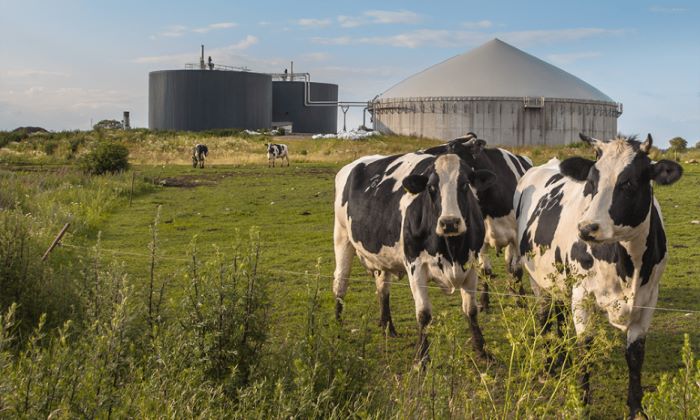
The process is deceptively simple. Manure, food waste and other organic residues are fed into sealed anaerobic digesters, where bacteria break them down in the absence of oxygen. The resulting biogas, rich in methane, is then upgraded into biomethane and injected directly into the national gas grid. Chemically identical to fossil gas, it can heat homes, fuel buses and power industry without requiring new pipes, boilers or cookers. What was once a disposal problem for farmers becomes a commodity, and what once leaked into the atmosphere as a powerful greenhouse gas is captured and put to work.
This approach has allowed the UK to build renewable energy capacity without the visible upheaval associated with wind farms or transmission lines. Dozens of plants already operate across England, Scotland and Wales, many based on dairy and beef farms, producing enough gas to heat entire towns. Industry estimates suggest that biomethane could eventually supply a significant share of domestic gas demand, easing dependence on imports while keeping energy spending closer to home. For rural communities, the plants bring new income streams, skilled jobs and a renewed sense of relevance in the energy transition.
The climate logic is compelling, if carefully bounded. Methane is far more potent than carbon dioxide in trapping heat, and manure left untreated emits it freely. Capturing that methane and burning it for energy converts it into CO₂ with a far lower warming effect, delivering immediate climate benefits. The remaining digestate, stripped of much of its methane potential, is returned to fields as fertiliser, reducing the need for energy-intensive chemical alternatives. In this sense, biomethane fits neatly into the language of the circular economy, closing loops between farming, waste and energy.
Yet it is not a miracle cure. The supply of manure and organic waste is finite, and sustainability depends on strict rules about what goes into digesters. Using dedicated energy crops on productive farmland risks undermining food security and environmental gains. There are also concerns about over-reliance on gas, even renewable gas, at a time when electrification of heating and transport is accelerating. Biomethane works best as a complement rather than a competitor to heat pumps, insulation and wind-powered electricity.
What the UK experience offers the rest of Europe is not just a technology but a model. Countries with strong agricultural sectors, from Ireland and France to Denmark and the Netherlands, have similar waste streams and gas infrastructure. Clear policy support, stable incentives and integration with farming systems are what have allowed Britain’s biomethane industry to grow. So too is public acceptance, the idea that green energy does not always look sleek and futuristic, and that some of the most effective climate solutions are earthy, practical and faintly unglamorous.
As Europe searches for ways to decarbonise without destabilising energy supplies or hollowing out rural economies, the British experiment with cow dung offers a useful lesson. Green energy does not have to arrive from distant horizons or vast offshore arrays alone. Sometimes it comes from the fields, the farms and the waste we would rather not think about. In turning manure into megawatts, the UK is reminding the continent that the path to a cleaner future may run through the most familiar and humbling of places.