





America’s Supreme Court Ruling – Resilience of American Institutional Checks and Balances
A hypothetical 6-3 ruling by the United States Supreme Court declaring that tariff authority rests solely with Congress rather than the president would mark one of the most profound recalibrations of American economic power in modern history. Beyond Washington’s partisan battles, such a decision would reshape global trade expectations, diplomatic relationships and market behaviour across continents.
For President Donald Trump, whose political identity has been closely tied to economic nationalism and aggressive tariff deployment, the judgment would impose limits not on rhetoric but on action. Tariffs have long served as a rapid negotiating instrument in his trade strategy, used to pressure allies and rivals alike. Under a constitutional restriction requiring Congressional approval, the pace and unpredictability that defined earlier tariff confrontations would inevitably slow.
The presidency would retain influence through persuasion and political pressure, but sweeping unilateral tariff announcements would become far more difficult to execute. Congressional approval introduces competing economic interests into the process, including exporters wary of retaliation, agricultural states dependent on foreign markets, manufacturers reliant on imported inputs and consumer advocates concerned about rising prices. The outcome would likely be moderation through negotiation rather than executive fiat.
Internationally, markets and governments would interpret such a ruling as a stabilising signal. For years, sudden tariff decisions from Washington have unsettled supply chains affecting steel, automobiles, agriculture and technology goods. Requiring legislative debate before tariffs take effect would offer businesses clearer timelines and advance warning of policy shifts. Predictability, long prized by investors, could encourage renewed long-term investment planning in Europe and Asia.
However, predictability comes with a trade-off. Tariffs have functioned as a swift coercive tool in diplomatic bargaining. Removing unilateral presidential authority weakens Washington’s ability to act quickly during negotiations or economic disputes. Foreign governments may feel less urgency to concede under pressure if policy changes must pass through Congress.
European capitals would likely welcome the change. The European Union has repeatedly clashed with Washington over duties imposed on steel, aluminium and automobiles. A return to institutional decision-making could ease retaliatory tensions and reopen stalled trade discussions across the Atlantic. Diplomatically, it would signal a shift away from personality-driven trade confrontation toward consensus governance.
India could also benefit from reduced uncertainty. American tariff threats have periodically complicated trade discussions involving pharmaceuticals, digital services and outsourcing industries. Greater predictability would strengthen investor confidence and allow New Delhi to negotiate bilateral agreements without fear of sudden disruptions.
China, at least initially, may emerge as a strategic beneficiary. Tariffs formed a central pillar of American economic pressure against Beijing during previous trade disputes. Congressional oversight would make rapid escalation more politically complex, particularly where lawmakers balance national security concerns against corporate and agricultural interests tied to Chinese markets. Economic rivalry would not disappear, but unilateral shocks could become rarer.
The diplomatic implications extend beyond specific countries. A judicial reaffirmation of constitutional limits would demonstrate the resilience of American institutional checks and balances. Negotiating partners may increasingly rely on Congressional consensus rather than presidential assurances alone. While this strengthens long-term credibility, it reduces the shock value that once defined Washington’s negotiating tactics.
A further complication lies in tariff revenues already collected under authorities potentially deemed unconstitutional or improperly exercised. Estimates suggest the United States accumulated roughly $292 billion through such measures. If courts allowed retroactive challenges, importers and corporations could seek refunds, exposing the federal government to costly litigation and widening fiscal deficits. Should refunds not be required, political controversy would likely persist over revenue derived from disputed authority.
Economically, tariffs have operated as indirect taxes paid by importers and frequently passed to consumers through higher prices. Curtailing unilateral tariff powers could ease cost pressures on manufacturers dependent on foreign components and potentially reduce inflation linked to import costs. Markets might welcome policy stability even as legal uncertainty surrounding past collections creates short-term caution.
Over the longer term, the ruling would point toward three possible outcomes. Reduced volatility in trade policy could encourage investment and supply chain expansion. At the same time, presidents might find themselves slower to respond to dumping or sudden foreign economic shocks. Ultimately, trade policy could return to a legislative process designed to balance workers, exporters and consumers through compromise.
More than a dispute over tariffs, the judgment would redefine the separation of powers in economic statecraft. It would determine how America deploys one of its most potent tools of economic influence and reshape expectations among allies and competitors alike. For some nations, predictability would restore confidence. For others, Washington’s slower decision-making could invite new tests of resolve. Either way, the centre of gravity in American trade policy would shift decisively from one office back to the halls of Congress.
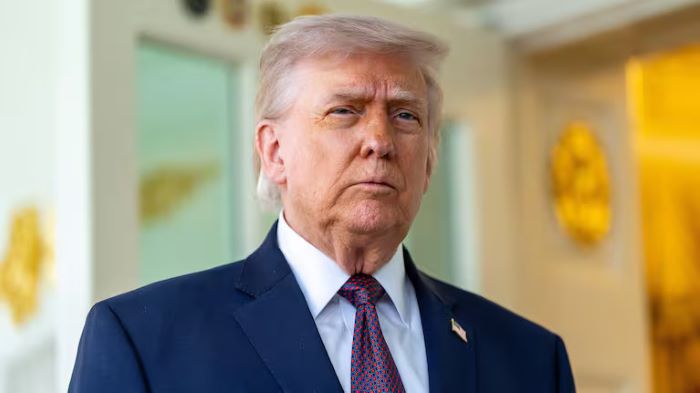
US President Donald Trump holds up a chart while speaking during a “Make America Wealthy Again” trade announcement event in the Rose Garden at the White House on April 2, 2025 in Washington, DC.
Photo – Chip Somodevilla/Getty Images via CNN Newsource