








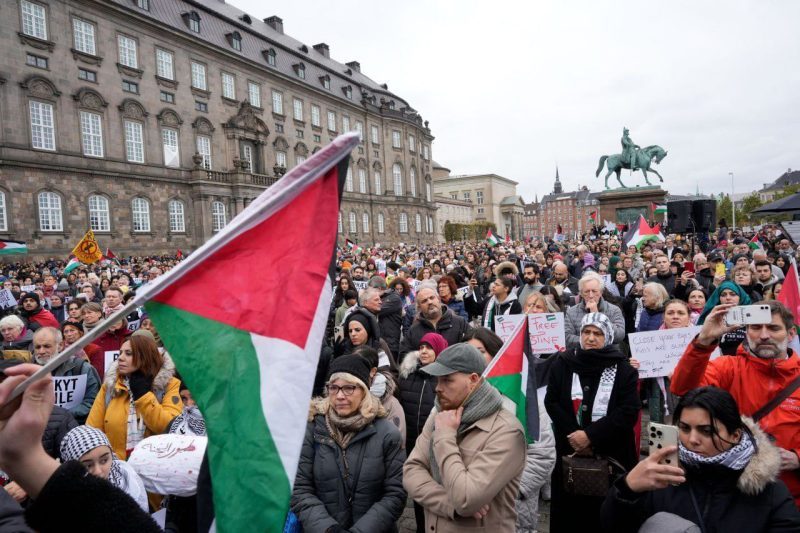
Luxembourg Demonstrators Demand Action on Gaza Crisis
Calls for justice over the war in Gaza have reached the heart of Luxembourg, exposing growing cracks between popular outrage and the government’s cautious diplomacy. This week, Luxembourg’s Parliament witnessed both fervent public demands and careful official hesitation as a petition for sanctions against Israel took center stage, highlighting the country’s uneasy role in the broader European response to the crisis.
The debate was prompted by a petition signed by more than 4,700 citizens—no small figure for this small nation—forcing lawmakers to hold a formal hearing. The petition accused Israel of systematic violations of international law, called for sanctions on Israeli leaders, and demanded the closure of Luxembourg’s trade office in Tel Aviv. Outside Parliament, protesters’ chants of “Shame on you!” reflected widespread anger at what they see as Europe’s moral paralysis.
Petitioner Dalia Khader spoke bluntly, accusing Israel of war crimes, apartheid, and ethnic cleansing. “You can’t turn cities into cemeteries and claim to be a victim. That’s terrorism,” she said. Fellow activist Catherine Elsen condemned the silence of Western governments, calling it grotesque that civil society must beg leaders to uphold fundamental principles. “If Europe is serious about human rights, now is the moment to prove it,” she said.
Luxembourg’s Foreign Minister, Xavier Bettel, responded with sympathy but urged caution. He stressed that meaningful sanctions would require agreement across the European Union. “If the EU-27 cannot agree, I will be the first to push for national sanctions—but only if they will be effective,” Bettel told Parliament. His remarks sought to balance Luxembourg’s moral commitments with the diplomatic and legal constraints of EU membership.
This careful positioning reflects a deeper historical entanglement. Since the early days of the European Economic Community, Luxembourg has tied its foreign policy tightly to that of its European partners. The EU itself has long endorsed a two-state solution as the only sustainable resolution to the Israeli-Palestinian conflict, a position Luxembourg has consistently supported. Luxembourg was among the first EU members to back elevating Palestine’s status at the United Nations. Yet when it comes to punitive measures like sanctions, Luxembourg has usually deferred to EU consensus, wary of fragmenting Europe’s common foreign policy.
Meanwhile, the United States—Europe’s critical transatlantic partner—has largely shielded Israel from international sanctions, vetoing repeated UN Security Council resolutions that sought to impose consequences. Luxembourg and other EU states have often found themselves constrained by this larger geopolitical reality, their own protests blunted by Washington’s firm backing of Israel.
Today’s public frustration in Luxembourg suggests that this longstanding approach is wearing thin. For many citizens, the images from Gaza—of bombed hospitals, starving children, and sprawling refugee camps—have shattered patience with cautious diplomacy. They see the EU’s emphasis on dialogue and humanitarian aid as insufficient in the face of what human rights groups, and increasingly the International Criminal Court, have termed possible genocide.
The Luxembourg petition specifically named Israeli Prime Minister Benjamin Netanyahu and former Defence Minister Yoav Gallant, both subject to arrest warrants by the ICC, as well as far-right ministers Itamar Ben-Gvir and Bezalel Smotrich, already under British sanctions. Petitioners argued Luxembourg has not only the right but the moral duty to impose similar measures, even if EU consensus proves elusive.
In response, Parliament assigned its scientific unit to explore the legal feasibility of unilateral sanctions. Bettel promised a thorough report before year’s end. His pledge was both a gesture to public sentiment and a recognition that inaction could carry its own political costs. Yet critics fear this process will only mire Luxembourg in more EU-level procedural delays.
Was this simply passing the buck to Brussels? Bettel insisted otherwise, arguing Luxembourg would not abandon the issue to endless EU wrangling. By promising to push for national measures if Europe stalls, Bettel signaled a willingness to diverge from the EU line—though carefully framed by the need for effectiveness and legality.
The likely outcome remains uncertain. A unilateral move by Luxembourg could set a precedent within the EU, emboldening other small states to act when consensus fails. It could also strain intra-European solidarity or provoke diplomatic pushback from Israel and the United States. Much depends on how forcefully the Luxembourg government follows through on Bettel’s promise and how the evolving humanitarian crisis in Gaza shapes European public opinion.
For now, the chants outside Luxembourg’s Parliament have faded, but the anger that fueled them has not. As winter approaches and Parliament awaits its legal study, Luxembourg faces a critical decision: whether to maintain its traditional alignment with EU caution or heed its citizens’ demand for moral clarity, even at diplomatic risk. Either choice will reverberate beyond this small Grand Duchy, testing Europe’s resolve—and conscience—in one of the most fraught conflicts of our time.