








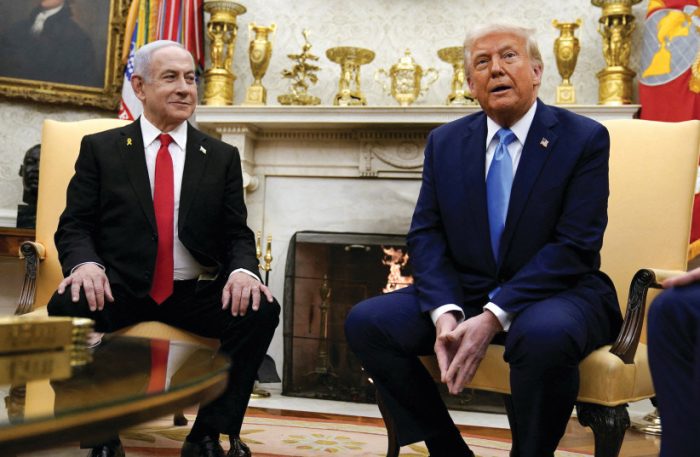
Trump’s Gaza Relocation Proposal
The recent announcement by former U.S. President Donald Trump, flanked by Israeli
Prime Minister Benjamin Netanyahu, about ongoing efforts to “relocate Palestinians out
of Gaza” has sparked global concern. Described by many as a renewed attempt at
ethnic cleansing, the plan seeks to pressure neighboring countries to accept
Palestinians from Gaza under the guise of offering them a “better future.”
But what does this mean for the region, for world order, and for the moral
responsibilities of world leaders?
Trump’s statement: “We’ve had great cooperation from surrounding countries”, may
sound diplomatic, but it masks a far more disturbing agenda – the forced displacement
of an indigenous population under military siege. Framing such relocation as a
humanitarian gesture not only distorts reality, but also dangerously redefines
sovereignty and international norms.
If implemented, this plan would normalize the uprooting of an entire population without
their consent, echoing historical atrocities from the Trail of Tears to the Nakba. Human
rights groups have already condemned the proposal as ethnic cleansing. Palestinians in
Gaza, despite enduring decades of occupation, blockade, and bombardment, have
overwhelmingly rejected any idea of abandoning their homeland.
Trump’s rhetoric, branding Gaza as the potential “Riviera of the Middle East”, is not only
tone-deaf, but imperialistic. It presents the Palestinian people as obstacles to be cleared
for the region’s real estate dreams. It also assumes the U.S. can unilaterally redraw
borders, dictate population movements, and assign fates, all without consulting those
most affected.
In doing so, Trump positions himself as a de facto Emperor of the World, using
American might and money to reshape the geopolitical landscape. It raises the
question: “Where are the checks and balances in global leadership? Can a single
individual or alliance override the collective will of a people and the long-established
norms of international law”?
This moment presents a heavy moral burden for world leaders, especially those in
democracies that preach human rights. Will they stand silently as a powerful nation
seeks to engineer demographic change through coercion and strategic alliances? Or
will they raise their voices against a policy that mirrors the very injustices the world
claims to have outgrown?
The idea of relocation cannot be detached from the broader context – a brutal war,
widespread displacement, and a population under siege. Offering Palestinians the
“option” to leave is like offering a drowning person the chance to climb aboard a ship
that’s already headed in the wrong direction.
True moral leadership demands protecting the rights of people to remain in their land, to
live with dignity, and to rebuild, not to be shipped off to accommodate geopolitical
whims.
Should this relocation plan advance, the repercussions could destabilize neighboring
Arab countries and provoke internal unrest. Jordan, Egypt, and Lebanon already host
large Palestinian populations and are wary of additional waves of refugees that could
upset fragile political balances. Moreover, forcibly relocating Palestinians would
extinguish the already dim hope of a two-state solution.
In essence, this is not just a plan for Gaza, it’s a redefinition of the Middle East,
orchestrated by foreign powers with vested interests and little accountability.
Trump’s plan represents more than a foreign policy misstep, it is a test of global
conscience. If the international community remains silent, it validates a world where
might overrides right, and where displacement becomes a tool for diplomacy.
Whether Trump is an emperor in self delusion or not, the implications of his vision for
Gaza stretch far beyond U.S. borders. The world must now decide whether it will resist
this modern imperialism, or simply rearrange the furniture while people’s homes are
stolen from beneath them.
Moji Danisa is a Nigerian journalist, media consultant, and social justice advocate