



Greek-Turkish Trade Ties Under Luxembourg’s Glare – Diplomacy, Pragmatism and Balancing
When European Union foreign ministers convened in Luxembourg for the latest Foreign
Affairs Council, attention was largely on the wars in Ukraine and the Middle East. Yet,
behind the scenes, quiet diplomacy was at work as Greece and Türkiye continued
cautious efforts to stabilise relations amid persistent regional and trade tensions.
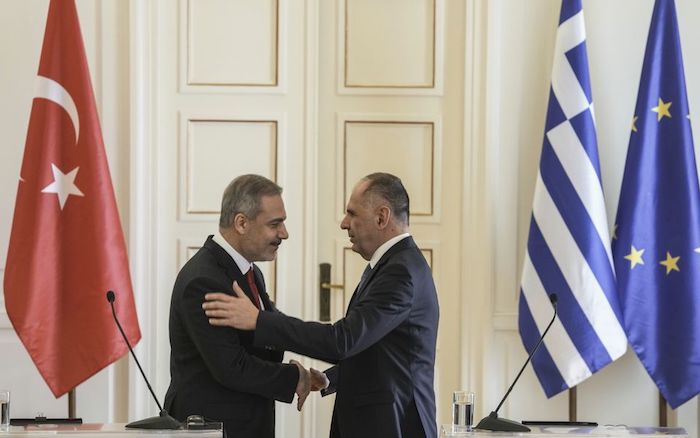
On the sidelines of the meeting, Greek foreign minister George Gerapetritis and his
Turkish counterpart Hakan Fidan held discussions aimed at maintaining momentum in
the fragile rapprochement between Athens and Ankara. Their talks focused on bilateral
disputes in the eastern Mediterranean, including maritime boundaries and energy
exploration rights but also underlined growing mutual economic interests that neither
side is willing to jeopardise.
Luxembourg, though not directly involved in the dispute, provided a symbolic and
practical setting for dialogue. The EU has long sought to encourage constructive
engagement between the two NATO allies, whose relationship oscillates between
strategic necessity and historical rivalry. The discussions in Luxembourg reflected this
delicate balance – diplomacy tempered by pragmatism, and rivalry softened by the
realities of trade.
Trade remains a critical bridge. Türkiye is one of the EU’s largest trading partners, with
a customs union that facilitates billions of euros in goods and services exchanged
annually. Greece, meanwhile, has steadily increased its exports to Türkiye in recent
years, particularly in agriculture, shipping services and energy-related sectors. Both
nations rely heavily on maritime trade routes through the Aegean and Mediterranean,
making stability in these waters an economic imperative as much as a political one.
For Brussels, the challenge lies in managing the relationship with Ankara without
undermining solidarity with Athens. Türkiye’s role in migration control, energy transit and
regional security makes it indispensable, yet its strained relations with some EU
members, notably Greece and Cyprus, complicate efforts at deeper cooperation.
European diplomats in Luxembourg stressed the need for continued dialogue while
insisting that respect for international law must remain non-negotiable.
The Luxembourg meeting also provided a platform for Greece to raise concerns about
Türkiye’s participation in certain EU mechanisms, including regional connectivity and
security programmes. Ankara, in turn, presented itself as a stabilising power committed
to maintaining open channels of communication and economic partnership with the
bloc.
No formal agreements emerged from the talks, but officials described the atmosphere
as constructive. “We are choosing dialogue over confrontation,” one EU diplomat said
after the meeting, reflecting a wider consensus that engagement – however incremental,
remains preferable to renewed escalation.
Analysts say that while the political divide between Greece and Türkiye remains wide,
trade has become the quiet anchor preventing relations from drifting into open hostility.
Tourism, shipping, textiles and agricultural goods continue to flow across borders,
sustaining thousands of jobs and reinforcing mutual dependence.
For the EU, whose ministers met in the same city that hosts many of its financial
institutions, the takeaway from Luxembourg was clear: economic interdependence can
be a stabilising force, even among uneasy neighbours. In a region where old rivalries
often flare without warning, it may be commerce, not diplomacy – that ultimately keeps
the peace.
Photo – Greek Foreign Minister George Gerapetritis (right) and his Turkish counterpart Hakan Fidan shake hands at the end of a join news conference, in Athens, on November 8, 2024. [Thanassis Stavrakis/AP]