








Belgium on the Brink: De Wever Threatens to Quit as Budget Crisis Deepens
Belgium’s fragile governing coalition is locked in a high-stakes standoff over the national budget, with Prime Minister Bart De Wever setting a Christmas deadline to reach an agreement or step down. The impasse, rooted in deep ideological divides and rising fiscal pressure, now threatens to push the country toward political paralysis at a moment of mounting economic strain.
At the heart of the dispute lies Belgium’s ballooning deficit, projected to reach about 4.5 percent of GDP this year, and a national debt hovering near 105 percent. Under scrutiny from the European Commission, which has placed the country under an Excessive Deficit Procedure, De Wever is demanding drastic action, a €10 billion savings plan through spending cuts and tax hikes. “We cannot continue pretending this is sustainable,” he said recently, warning that failure to act could cripple the welfare state.
However, his call for austerity has split his six-party “Arizona coalition,” a fragile alliance of Flemish nationalists, socialists, Christian democrats, and French-speaking liberals. The partners remain sharply divided on how to balance the books. De Wever’s proposal to freeze automatic wage indexation – a cornerstone of Belgium’s post-war social model – has drawn fierce opposition from socialist ministers and trade unions. Plans to raise the value-added tax and tighten pension and unemployment rules have only widened the rift.
Meanwhile, thousands have taken to the streets of Brussels and other cities to protest what they see as a betrayal of workers. Unions warn that higher taxes and benefit cuts will erode living standards already squeezed by inflation and housing costs. “Ordinary people didn’t create this crisis,” one protester said. “Why should we pay for it?”
The budget deadlock is more than a domestic headache. Belgium’s finances are under growing scrutiny from European partners concerned about fiscal discipline amid high interest rates. Failure to deliver a credible plan could expose Brussels to EU sanctions, further undermining investor confidence in the eurozone’s heartland. Economists warn that a collapse of the government, or prolonged uncertainty, could stall growth and deepen the sense of instability that has haunted Belgian politics for years.
De Wever’s ultimatum – reach a deal by Christmas or resign – has turned the countdown into a national drama. His threat is seen both as a negotiating tactic and a reflection of mounting frustration within his own ranks. Political analysts say the likelihood of a complete government collapse remains high, but not inevitable – coalition partners may still compromise rather than risk fresh elections and another round of drawn-out coalition talks.
For ordinary Belgians, however, the outcome may bring little relief. Whether the government survives or falls, austerity looms. Wages could stagnate, taxes may rise, and the public sector faces cuts. In a country already weary of political gridlock, this Christmas deadline is more than a test of De Wever’s leadership, it is a test of Belgium’s capacity to govern itself.
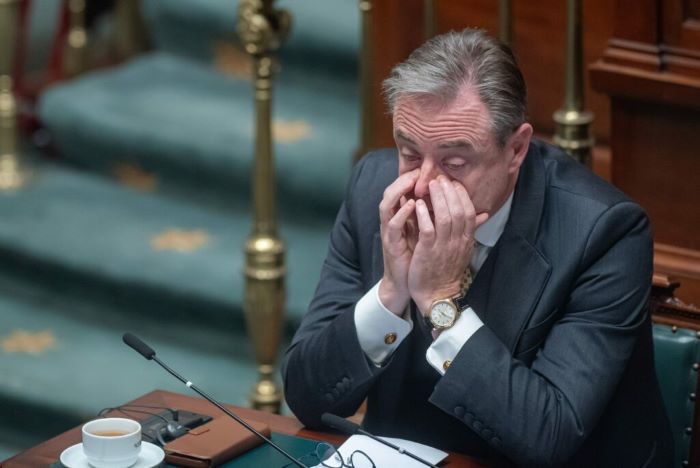
Photo – Belgium’s Prime Minister Bart De Wever (N-VA) during a plenary session in the Federal Parliament in Brussels, Thursday 16 October 2025. Credit: Belga/Jonas Roosens