








Evolution Under Duress – Genetic Changes in Polar Bears Worry Scientists
The Arctic has always been a place of slow rhythms and ancient balances, where change arrived over centuries rather than seasons. That tempo has been shattered. As sea ice retreats and temperatures rise at unprecedented speed, scientists are beginning to see signs that polar bears – icons of a frozen world – may be undergoing subtle genetic shifts as they struggle to survive. It is evolution under duress, unfolding not in the deep past but in the present tense.
Polar bears are among the most specialised mammals on Earth. Their bodies, metabolism and hunting strategies are finely tuned to life on ice, where they stalk seals across frozen seas. As the ice disappears earlier each year and returns later, bears are forced to travel farther, fast longer and spend more time on land, where food is scarce and competition is fierce. Against this pressure, researchers have detected changes in gene activity linked to heat stress, fat metabolism and ageing in some polar bear populations. These shifts do not mean the species is suddenly becoming “heat-proof”. Rather, they suggest that individuals carrying traits better suited to warmer, more variable conditions may be gaining a fragile edge.
This is not adaptation in the comforting, cinematic sense of nature finding a way. It is a biological emergency response. Evolution, usually glacially slow, is being pushed to operate on a human timescale. The danger is that climate change is moving faster than even the most flexible genomes can follow.
Hybridisation has added another unsettling dimension. As warming opens new territory, polar bears and brown bears are encountering each other more often. Their occasional offspring hint at a possible genetic escape route, with traits that might help bears cope with land-based living. Yet such mixing is rare and uneven, and it raises troubling questions about the long-term survival of polar bears as a distinct species. Survival through dilution is a bleak bargain.
What is happening in the Arctic is not an isolated story. Across the planet, other species are being forced into rapid change. Insects are altering their life cycles to match shifting seasons. Some birds are breeding earlier, migrating differently or shrinking in body size to shed heat more efficiently. Plants are flowering sooner and moving uphill or poleward, while marine species are changing distribution as oceans warm and acidify. In each case, natural selection is favouring traits that fit a new climate reality.
But these responses reveal a hard truth: adaptation is uneven. Species with large populations, short lifespans and wide ranges stand a better chance of keeping pace. Specialists, long-lived animals and those already pushed to the margins are far more vulnerable. For them, evolution may arrive too late or not at all.
The consequences reach far beyond individual species. As organisms shift, mutate or vanish, ecosystems are being rearranged. Familiar food chains fracture. New combinations of species emerge, some unstable, others favouring pests and pathogens. The planet may remain biologically active, but it will be biologically altered, with fewer of the complex, finely balanced systems that humans depend on for food, water and climate stability.
There is a temptation to see these evolutionary changes as reassurance – proof that life will endure whatever humans inflict. That is a dangerous misreading. Evolution under extreme pressure is not a sign of resilience but of stress. It tells us how close many species are to the edge, and how much has already been lost.
For polar bears, the message is stark. No mutation can replace sea ice. No genetic tweak can conjure seals where oceans no longer freeze. Their struggle is a warning written into DNA itself – the living world is being forced to gamble its future on rapid change, while the drivers of that change remain largely unchecked.
Evolution is happening before our eyes, but it is not a solution. It is a signal – urgent, unambiguous, that the climate crisis has moved from models and forecasts into the bodies of the creatures that share this planet with us.
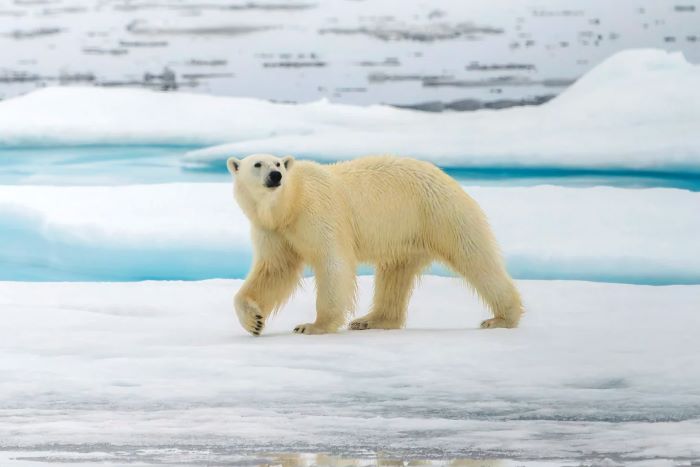
Photo – Genes linked to heat stress, aging and metabolism behaved differently in bears that live in warmer climates.Alberto Cassani / Getty Images file