


Luxembourg’s Quiet Turn Toward Long-Range Air Defence
For a state whose security has long rested on alliances rather than armaments, Luxembourg’s interest in acquiring a long-range air-defence system marks a notable shift. The Grand Duchy’s exploration of EU SAFE financing to support a possible purchase of the next-generation SAMP/T air-defence system reflects a changing European security landscape in which even the smallest countries are reassessing what collective defence now requires of them.
The timing is not accidental. The war in Ukraine has altered assumptions about air superiority across the continent, exposing how vulnerable civilian and military infrastructure can be to missiles, drones and long-range strikes. What once seemed a remote threat to western Europe has become a daily reality on NATO’s eastern flank, prompting governments far from the front line to rethink their exposure. For Luxembourg, nestled between larger neighbours and hosting key financial and institutional infrastructure, the question is no longer whether it could defend its airspace alone, but how it contributes meaningfully to a shared European shield.
Cost has always been the decisive constraint. Long-range air defence systems are among the most expensive pieces of military hardware, demanding not just initial investment but decades of maintenance, training and integration. The EU’s SAFE instrument alters that calculation. By offering long-term, low-interest financing for strategic defence acquisitions, SAFE allows smaller states to consider capabilities that were previously out of reach. Luxembourg’s interest in using this mechanism suggests a deliberate effort to align national security planning with emerging EU defence tools rather than relying solely on bilateral arrangements or NATO frameworks.
The choice of the Franco-Italian SAMP/T NG system is equally revealing. It signals a preference for a European-built solution at a moment when defence procurement has become inseparable from industrial policy. Across the continent, governments are under pressure to reduce reliance on external suppliers and to strengthen Europe’s own defence industrial base. For Luxembourg, buying European equipment is less about symbolism than about embedding itself in shared supply chains, training structures and operational doctrines that bind member states closer together.
Luxembourg is far from alone in this recalibration. Denmark has recently opted for the same SAMP/T NG system, while France and Italy are upgrading their own air-defence capabilities. Elsewhere, countries are assembling layered systems combining short-, medium- and long-range interceptors to guard against increasingly complex aerial threats. The common thread is urgency: Europe’s air-defence network remains fragmented, and the gap between ambition and capability has become harder to ignore as geopolitical tensions intensify.
For Luxembourg, the strategic value of such a system would lie less in defending its limited airspace and more in its contribution to collective defence. Integrated into NATO and EU command structures, a Luxembourg-based or Luxembourg-funded capability would reinforce regional coverage and signal political commitment to burden-sharing. In a security environment where credibility matters, participation can be as important as scale.
Yet the move also raises questions. Long-range air defence demands personnel, technical expertise and sustained political support. There is the issue of whether Luxembourg would operate the system independently or pursue a joint arrangement with neighbours, pooling assets and responsibilities. Such cooperation would fit the logic of both SAFE and the Benelux tradition of defence collaboration, but it would also require delicate negotiations over sovereignty, command and cost-sharing.
Luxembourg’s exploration of long-range air defence should therefore be read not as militarisation, but as adaptation. It reflects a broader European recognition that security guarantees must be underpinned by real capabilities, and that solidarity increasingly involves tangible contributions rather than symbolic commitments. In that sense, the Grand Duchy’s quiet turn toward the skies mirrors a continental shift: a Europe learning, belatedly, that peace also requires preparation.
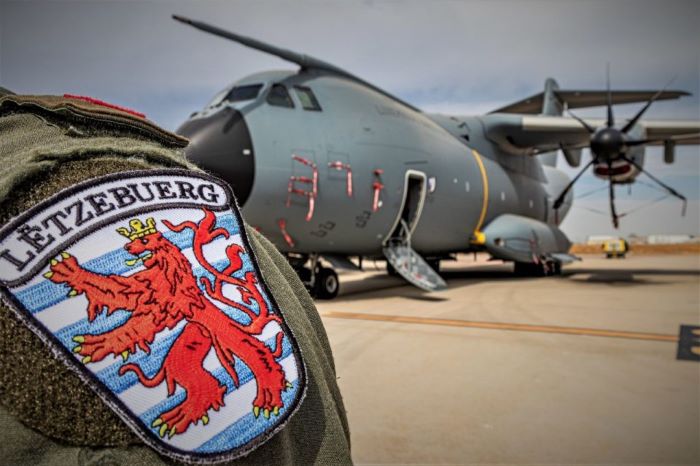
Photo – © Armée luxembourgeoise