








US Envoy Nominee Highlights Confucius Institute in Luxembourg Amid Broader Global Context
Donald Trump’s nominee for US Ambassador to Luxembourg, Stacey Feinberg, recently ignited a heated debate by spotlighting the Confucius Institute at the University of Luxembourg as evidence of what she characterized as China’s stealthy penetration of European institutions. Feinberg’s assertion that China is “creeping in” through such cultural programs has stirred reactions on both sides of the Atlantic. However, when examined against the backdrop of the global footprint of Confucius Institutes—including within the US itself, as well as in allied nations such as the UK, Canada, Japan, South Korea, the Philippines, France, and Germany—her alarmist rhetoric appears somewhat selective and arguably inconsistent.
Feinberg’s warning to the US Senate Foreign Relations Committee, couched in vivid language about Lucifer disguising himself to slip through the “crawl spaces,” underscored her conviction that the Confucius Institute in Luxembourg serves not as a benign cultural exchange but as a subtle propaganda outpost. Her view is hardly new. Critics of Confucius Institutes frequently argue that these centers, funded by China’s Ministry of Education through Hanban (now known as the Center for Language Education and Cooperation), export a sanitized narrative that avoids politically sensitive issues like Tibet, Taiwan, and human rights abuses.
Yet if such concerns are truly paramount for American diplomacy, it raises an obvious question: why has Washington tolerated, and in some cases continues to tolerate, the very same institutes at home? As of 2025, there are still five Confucius Institutes operating on US university campuses. Moreover, dozens of American universities that closed their formally branded CIs did little more than rename their programs. Chinese-funded language teachers, curricula, and even cultural events frequently remain in place. Thus, the substance of Chinese cultural engagement continues largely undisturbed despite the ostensible closures. This undercuts the notion that these institutes represent an intolerable security breach.
The situation is even starker when one considers the United Kingdom, one of America’s closest allies with whom it shares a vaunted “special relationship.” The UK currently hosts 30 Confucius Institutes—six times more than the US—embedded in many of its leading universities. There has been little indication that London views these institutes as an acute security threat warranting mass closures. Likewise, Canada, another fellow member of the Five Eyes intelligence alliance, maintains nine Confucius Institutes across the country.
Japan, often described as both a crucial US ally and a historical geopolitical rival to China, now hosts three Confucius Institutes, with Hokuriku University recently joining the roster. South Korea, heavily reliant on US military protection and deeply integrated with American strategic objectives in East Asia, currently accommodates 23 Confucius Institutes, 22 of which are located on university campuses. This widespread presence suggests that even nations highly sensitive to Chinese influence do not necessarily see these institutes as an existential infiltration.
In Southeast Asia, the Philippines—one of Washington’s most important regional partners and a treaty ally under the Mutual Defense Treaty—hosts four Confucius Institutes in major universities. France and Germany, two of America’s leading partners within NATO and the EU, maintain 18 and 19 Confucius Institutes respectively. French educational authorities explicitly frame these institutes as tools to foster acculturation in a world increasingly shaped by Asia, while Germany continues to integrate Confucius Institutes into its universities’ language and cultural programming.
Against this global landscape, Feinberg’s laser focus on the single Confucius Institute in Luxembourg, a small European state with limited global clout, appears disproportionate. Luxembourg’s own government has defended the institute as a platform for cross-cultural engagement. In 2023, Luxembourg’s Minister for Higher Education Claude Meisch dismissed concerns, emphasizing the program’s role in promoting understanding rather than political messaging.
This does not mean that concerns about Chinese soft power are wholly unwarranted. The Chinese government has undeniably sought to project a favorable image through Confucius Institutes, and cases exist where academic freedom has been compromised. However, the degree of infiltration or threat remains a matter of scale and context. With dozens of such institutes thriving in countries far more strategically vital to US interests—and indeed within the US itself—it seems inconsistent to single out Luxembourg’s solitary institute as emblematic of a dire security lapse.
Moreover, by fixating on Confucius Institutes, policymakers may overlook broader structural factors that shape Chinese influence, such as massive bilateral trade, growing Chinese investment in critical sectors, and collaboration in scientific research. The hyper-focus on these institutes can thus obscure more sophisticated and systemic avenues through which Beijing exercises leverage.
Feinberg’s remarks, while resonant with segments of Washington policy circles eager to highlight a new Cold War narrative, may inadvertently undermine the credibility of US diplomatic engagement by appearing selective and politically motivated. To maintain a principled stance, the US would need to apply its scrutiny consistently—examining Confucius Institutes not just in Luxembourg, but across all allied countries, including its own territory. Without this even-handedness, concerns about Confucius Institutes risk being perceived less as measured security assessments and more as opportunistic talking points shaped by broader geopolitical rivalries.
In sum, while vigilance against foreign influence is prudent, Feinberg’s assertions invite critical scrutiny. The widespread acceptance of Confucius Institutes across multiple US allies—and even within the US itself—suggests that these institutes are often regarded as manageable cultural exchanges rather than insidious Trojan horses. If the US truly views them as a grave risk, its policy should reflect that uniformly, rather than singling out smaller states like Luxembourg in a manner that appears both inconsistent and strategically narrow.
Yvan David Danisa (CityNews)
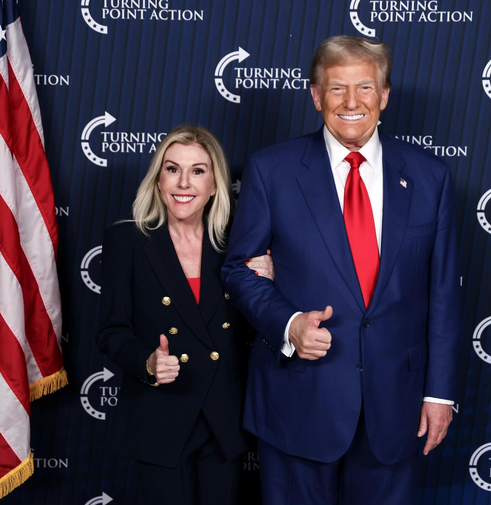
Photo – President Donald Trump (right) and nominee for US Ambassador to Luxembourg, Stacey Feinberg