






Overview of Luxembourg’s Inflation Trends as Latest Rate Rises to 2.2%
Luxembourg has experienced moderate but persistent inflation since 2023, shaped
primarily by fluctuations in energy prices, food costs, and services. According to the
National Institute of Statistics and Economic Studies (STATEC), the country’s inflation
dynamics reflect both international market volatility and domestic consumption patterns.
As of June 2025, the annual inflation rate stood at 2.2%, a slight increase from 2.0% in
May. Core inflation, which excludes energy and unprocessed food, remained steady at
2.3%, indicating that underlying price pressures have not significantly eased.
In June 2025, the national consumer price index rose by 0.1% compared to the previous
month. This modest increase came after a period of declining energy prices, marking a
turning point for petroleum-related products. Petroleum prices rose by 1.4% in a month,
following three months of consecutive decline. The cost of a petrol refill increased by
2.5%, while diesel prices rose more modestly at 1%. Heating oil saw a sharper rise at
4.1%, whereas coal gas decreased by 1%. Despite the monthly increases, prices for
petroleum derivatives were still slightly below levels from June 2024.
Food prices also contributed to the inflationary pressure, rising 0.5% compared to May
2025, and 2.3% year-on-year. Notable increases were recorded in meat products, with
pork prices up by 2.4%, chicken by 1.8%, and beef and veal by 1.2%. Dried fruits and
nuts climbed by 3.1%, while sodas and lemonades increased by 2.1%. However, these
rises were partially offset by declines in mineral water (-3.1%), eggs (-1.7%), and
confectionery (-1.0%).
Personal care products also experienced inflation, with prices for personal hygiene
items increasing by 2.1%, reinforcing the overall upward trend in consumer prices.
In the service sector, prices rose by 2.5% over the year, slightly down from 2.6% in the
previous month. There was a marked increase in holiday-related spending (+6.3%) and
financial services (+1.2%), reflecting seasonal and consumer behavior trends. On the
other hand, day care and after-school care services saw a seasonal decline of 4.2%,
and air travel dropped significantly by 12.6%, helping to moderate service inflation.
A key domestic factor influencing inflation is wage indexation, which was triggered in
May 2025. This mechanism, which adjusts wages in response to inflation, boosted
purchasing power and contributed to a spike in consumption. However, by June,
services prices had stabilized.
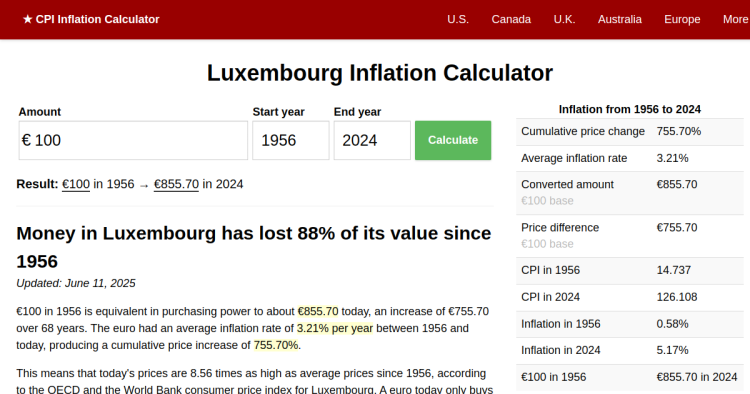
The general consumer price index (CPI) for June 2025 was 125.82 points, based on a
2015 reference base of 100. The half-yearly average CPI rose from 1019.75 to 1024.27,
moving closer to the next indexation threshold of 1038.79, which would again trigger
wage adjustments.
Overall, while Luxembourg’s inflation remains moderate by European standards, its
upward trajectory in recent months underscores ongoing price pressures, particularly
from energy and food sectors. Wage indexations and seasonal spending trends
continue to play significant roles in shaping the economic landscape. STATEC’s updates
suggest that unless global commodity prices stabilize or domestic consumption cools,
inflationary pressures may persist into the latter half of 2025.