



Vote to Keep Tel Aviv Trade Office: Luxembourg’s Big Moral Miss
In a world increasingly attuned to human suffering, the debate in Luxembourg’s parliament over whether to close its Trade and Investment Office (LTIO) in Tel Aviv laid bare profound tensions between principle, political calculus, and economic self-interest. It was more than a mere administrative squabble — it was a test of Luxembourg’s moral mettle in the face of a humanitarian crisis of staggering proportions.
The immediate context is tragically clear. Israel’s ongoing assault on Gaza, ostensibly a response to Hamas’s brutal October 7 attacks, has now killed at least 57,500 people and left more than 135,000 wounded. Entire families have been wiped out, whole neighborhoods flattened. The images are relentless. And yet, as David Wagner of déi Lénk reminded his colleagues, “history has its eyes on us.” His motion, co-signed by LSAP and supported by the Greens and the Pirate Party, sought to close the LTIO — a symbolic yet potent rebuke meant to communicate that Luxembourg will not be complicit, however indirectly, in the machinery of occupation and disproportionate violence.
For opponents of the motion, led by Prime Minister Luc Frieden’s coalition and Foreign Minister Xavier Bettel, the argument rested on two pillars: legalistic caution and economic prudence. Bettel insisted Luxembourg lacked a “legal basis” to impose such measures without EU consensus. Laurent Zeimet of the governing CSV went further, asserting that Israel is the “only democracy in the region” and shouldn’t be singled out for the turmoil of its neighbourhood.
This framing was met with powerful counterpoints. The Pirate Party’s Sven Clement rightly argued that democracies must be held to standards, particularly regarding human rights. Green MP Sam Tanson pointed to the daily televised violations, asking how much more evidence was needed. Yves Cruchten of the LSAP cut to the core: if Europe could muster 18 sanction packages against Russia for Ukraine, how is it that none exist for Israel’s well-documented breaches? Indeed, Luxembourg’s own trade volumes with Israel are modest: roughly US $35.29 million in exports and US $34.95 million in imports last year, a fraction of its dealings with Germany or France. Is this really a strategic relationship so vital that even symbolic action is inconceivable?
Bettel’s insistence that unilateral moves achieve “nothing” sounds hollow against the courage of other small EU nations. Ireland and Spain did not await a mystical unified EU position before announcing their recognition of Palestinian statehood. They understood that foreign policy is also a declaration of national values, not merely an output from Brussels. As human rights lawyer François Dubuisson put it, Luxembourg may be small, but its financial clout makes it matter. Choosing to act — or not — has real consequences.
The Prime Minister also warned of nebulous laws that would supposedly be broken. But under what statute does refusing to do business with a nation actively bombarding civilians become illicit? Meanwhile, countless UN resolutions demanding Israel halt settlement expansions and respect Palestinian rights are ignored with impunity, voted down annually with little consequence. Where is the balance? Where is the equity Bettel so earnestly invoked?
Zeimet’s remark that Israel’s democratic character should shield it from criticism eerily recalls the rhetorical shields once deployed by Western leaders to excuse apartheid South Africa. After all, under apartheid there were elections — just not for everyone. Democracy is more than ballots for some; it is also equality before the law and human rights. By that fuller definition, Israel’s occupation and the apartheid determination of respected international bodies stand as damning.
Yet despite the disappointing result, the debate revealed something admirable. It offered a rare, unvarnished look at foreign policy being contested on the floor of parliament, a domain usually cloaked from voters. Citizens of Luxembourg could see which parties stood on principle. They saw the eloquence and moral force of David Wagner, who will be remembered for putting the issue squarely on record. They saw Cruchten’s clarity and Tanson’s refusal to look away. They saw how the Pirate Party pressed uncomfortable questions about who really benefits from the LTIO. This is democracy in its rawest, most valuable form — uncomfortable, impassioned, and public.
It was also in the testimonies from outside the chamber that the case for action found its deepest moral resonance. Dalia Khader of Jewish Call for Peace, François Dubuisson, actress Catherin Elsen — they laid out the stakes with a simplicity the government’s evasions could not match. They reminded parliament that beyond trade figures and diplomatic caution, there are obliterated homes, traumatized children, and a moral stain that grows deeper with each unchallenged atrocity.
For politicians keen on future elections, there’s a lesson too: avoid cozy entanglements that become liabilities in crises of conscience. The government’s defense of its position felt precisely like that — an uncomfortable contortion, inferior to the clarity offered by the opposition.
In the end, the motion failed. The LTIO will remain open. But something lasting was won. Luxembourg’s voters were treated to a vivid tableau of who stands where, and why. In questions of foreign policy — whose foundation is always domestic — that clarity is priceless. It ensures that when the next debate arises, the people will remember not only the votes cast, but also the voices that rang with conscience.
Opinion Analysis – David Danisa
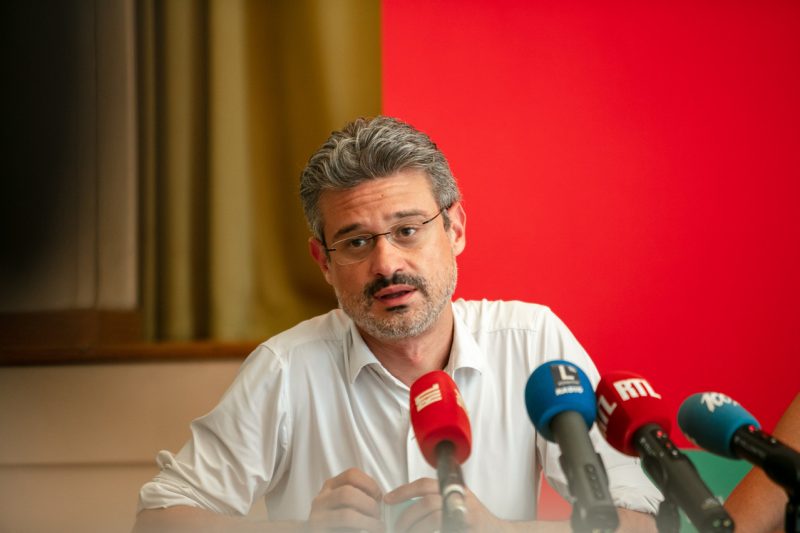
David Wagner (déi Lénk), Member of the Chamber of Deputies – photo by Romain Gamba