







A Tightrope of Diplomatic Evasion – Luxembourg’s Palestine Policy
The Luxembourg government’s approach to the question of Palestine, under the dual stewardship of Prime Minister Luc Frieden and Foreign Minister Xavier Bettel, has increasingly become a masterclass in diplomatic equivocation. Despite the weight of history, the urgency of present atrocities, and the evolving consensus among several European states, Luxembourg remains a study in ambiguity. While Xavier Bettel has consistently framed Luxembourg’s foreign policy as principled and grounded in international law, his elusiveness on the two-state solution and recognition of Palestine is nearing levels of contradiction that stretch the very meaning of coherence in international diplomacy.
The core of the issue lies in the fundamental inconsistency between Luxembourg’s professed support for a two-state solution and its hesitancy to recognize the Palestinian state formally. This is not merely a matter of timing or coordination with broader European sentiment. Rather, Bettel’s statements have often appeared to both endorse and avoid the same position within the same breath. He claims that Luxembourg is “leaning” towards recognition, yet refuses to commit to any decisive timeline or coordinated effort. The effect is a foreign policy that appears both cautiously principled and strategically noncommittal, but in practice, it has become structurally ambiguous and politically anaemic.
A survey of press statements and public pronouncements over the years reinforces the view of a foreign minister who navigates the Palestine issue less as a diplomat seeking peace and more as a politician managing risk. Bettel’s legacy, from his tenure as Prime Minister to his current post as Foreign Minister, is peppered with rhetorical nods to human rights and international law, but rarely do these affirmations translate into concrete policy moves. Whether at the United Nations General Assembly or in EU foreign policy forums, Luxembourg under Bettel has consistently avoided the kind of decisive language employed by peers such as Ireland, Spain, or even France, whose President Emmanuel Macron recently announced an intention to recognize the Palestinian state by September.
Unlike Hungary, which takes a pro-Israel stance with ideological consistency, Luxembourg opts for moralistic language without policy follow-through. This puts the Grand Duchy in a peculiar position. On one hand, it wants to maintain the appearance of a small but morally engaged European actor. On the other, it stops short of taking the political steps that would give its values-driven rhetoric real diplomatic weight. The result is a credibility gap that undermines Luxembourg’s international standing, especially when juxtaposed against European states that have taken definitive stands—even if those stands are controversial or politically costly.
It is difficult to ignore the role of Xavier Bettel in shaping this ambivalence. While Frieden, as the newer figure in the prime ministerial role, has yet to assert a strong independent foreign policy identity, Bettel’s longstanding control over Luxembourg’s international posture suggests that this cautious evasiveness is not accidental. Bettel appears to view Luxembourg’s interest in the Middle East as primarily reputational, opting for gestures that allow Luxembourg to sit at the diplomatic table without truly challenging the dominant Western line or risking bilateral tensions with Israel. His calls for EU-wide action often serve more as a rhetorical shield than a policy mechanism, allowing Luxembourg to defer responsibility by invoking collective paralysis.
The strategic reasoning behind this could lie in Luxembourg’s political geography and economic networks. As a small country nestled between larger EU powers, with a strong financial sector and a carefully managed diplomatic profile, Luxembourg may perceive assertive action on Palestine as a potential risk to its broader interests. Yet this same logic is being disproved by the actions of similarly sized states like Ireland and Norway, who have found ways to assert moral leadership without alienating key partners.
Looking at Luxembourg’s voting record at the United Nations General Assembly over the last decade, there is little evidence of a meaningful shift under Bettel’s influence. The country has often abstained or voted in favor of non-binding resolutions supporting Palestinian rights, but rarely with the clarity or urgency demanded by the situation on the ground. Even after the intensification of the war in Gaza, and international legal developments such as the ICC’s case against Israeli leaders for potential war crimes, Luxembourg’s response has remained hedged and deferential.
This ambiguity is not merely unsustainable; it is increasingly out of step with the global moment. As the humanitarian crisis in Gaza deepens, and as the international legal framework begins to reckon with Israeli military conduct, the stakes are too high for fence-sitting. Luxembourg’s approach, couched in careful legalism and cloaked in diplomatic civility, begins to look less like prudence and more like paralysis.
One must also consider the democratic dimension. Luxembourg’s public, like many across Europe, is increasingly aware of and vocal about the Gaza crisis. Bettel’s hedging may serve a short-term political purpose, but it risks alienating a growing segment of voters who expect a foreign policy that matches the country’s stated values. To ignore this sentiment is to mistake political caution for political wisdom.
In the final analysis, Luxembourg’s position on Palestine reflects a deeper tension between identity and agency. The country wishes to be seen as a responsible global actor, but it often avoids the assertiveness required to live up to that aspiration. Xavier Bettel’s leadership has, for all its diplomatic fluency, rendered Luxembourg’s stance on Palestine less a policy than a puzzle, one in which the pieces change shape with each passing statement. Unless the current coalition can articulate a coherent, principled, and timely position on the two-state solution, Luxembourg risks becoming a cautionary tale of how foreign policy can drift into irrelevance through the sheer weight of its own equivocations.
David Danisa Opinion, CityNews
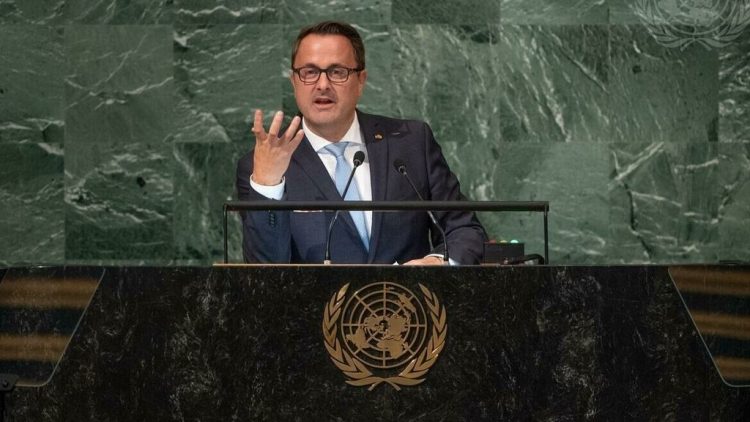
Photo – Xavier Bettel, Deputy Prime Minister and Minister for Foreign Affairs, Foreign Trade, International Development, Cooperation and Humanitarian Affairs