






Luxembourg’s High Resilience Ranking: Why it Matters More Than Ever
Luxembourg’s second-place ranking in the 2025 FM Global Resilience Index, just
behind Denmark and ahead of economic powerhouses like Norway, Switzerland and
Singapore, might sound like technical accolade, but it speaks volumes about how the
tiny duchy is quietly consolidating itself as one of the world’s most future-ready nations.
With a score of 99.5 out of 100, Luxembourg has once again proven that resilience in
the face of economic shocks, geopolitical upheavals, and climate uncertainty is not just
about wealth, but about foresight, governance, and the ability to adapt. In a year marked
by deepening conflicts in Ukraine and the Middle East, supply chain instability, and the
growing spectre of cyber warfare, Luxembourg’s ability to remain a safe, stable, and a
well-governed jurisdiction offers both reassurance and strategic advantage.
Resilience, as measured by FM Global, goes beyond GDP and productivity. It is about
how well a country can withstand and recover from shocks – economic, environmental,
and technological. Luxembourg’s top marks for inflation control (99.6), digital access
(99.3), and low greenhouse gas emissions (99.0) signal that the country is managing
both its present and its future.
The Index’s expanded focus on cyber risk in 2025, a reflection of AI-driven
vulnerabilities and industrial automation, is particularly relevant to Luxembourg. Despite
the July cyber outage at Post, the country’s significant investment in cybersecurity and
digital infrastructure has paid dividends, both in prevention and response.
Moreover, perfect scores for seismic risk and water stress reflect geographical and
environmental advantages but it is how the country capitalises on these through policy
and investment that sets it apart.
To the average citizen, resilience may seem like an abstract concept but it affects
everything from the stability of jobs and pensions to the continuity of healthcare,
transport and public services during global disruptions. It is what ensures that schools
stay open during crises, supply chains remain functional, and governments don’t spiral
into austerity or reactionary politics when faced with global turbulence.
For businesses and investors, Luxembourg’s ranking is more than bragging rights, it is a
benchmark. The FM Global Resilience Index is widely consulted by multinationals and
insurers looking to de-risk their global operations. A high score makes Luxembourg an
attractive destination for headquarters, data centres, and green investments. In a world
increasingly defined by volatility, resilience becomes currency.
Luxembourg’s consistent performance reflects a model of governance where long-term
planning trumps short-term populism. Its prudent fiscal management, low corruption
levels, investment in education and infrastructure, and commitment to sustainability
place it in a rarefied global category, small but deeply influential.
As the world grapples with climate adaptation, cyber threats and shifting alliances,
Luxembourg’s resilience is not just a national asset, it is a regional stabiliser and a
beacon for how small nations can punch well above their weight in global affairs.
The message from this year’s FM Index is clear, in an age of fragility, resilience is
power- Luxembourg, quietly and efficiently, is becoming one of the most powerful small
states in the world.
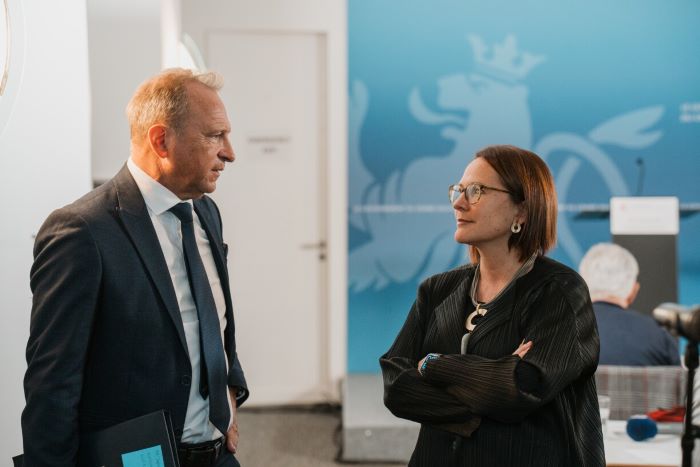
Photo – Luc Frieden, Prime Minister of Luxembourg