





Flemish Government Pushes Dutch in Brussels Amid Fears of French Dominance
The Flemish government has launched a sweeping plan to strengthen the use of Dutch
in Brussels, reopening one of Belgium’s most sensitive debates – the linguistic balance
in the capital and the political faultlines that run through the federation.
The “ToTaalplan”, presented by Cieltje Van Achter, the Flemish minister for Brussels
from the nationalist N-VA party, combines extra language support for children, buddy
schemes linking French-speaking teenagers with Flemish students, visibility campaigns
in shops and restaurants, and a pilot project to increase bilingualism among hospital
staff. Flemish subsidies will also be tied more closely to Dutch-language provision, with
organisations that fail to offer services in Dutch at risk of losing funding.
“People who speak other languages have too few opportunities to practice Dutch in
Brussels,” Van Achter said. “Flemish people also tend to switch too quickly to French or
English, which makes it harder for non-native speakers to gain confidence in Dutch.”
For Flemish politicians, the concern is not just cultural but political. Dutch, the majority
language in Belgium and dominant in the wealthy Flanders region, is spoken at home
by barely one in ten residents of Brussels. Despite constitutional guarantees of
bilingualism, hospitals, police forces and public services have been repeatedly accused
of prioritising French, leaving many Flemings feeling their rights are ignored in the city
that also houses the EU institutions.
The N-VA has long linked such concerns to its wider push for con-federalism, under
which Flanders and Wallonia would hold more power while Brussels’ status remains
contested. Defending the Dutch in the capital, party leaders argue, is part of defending
Flemish identity within a fragile federal system.
Yet Francophone parties and campaigners see measures like the ToTaalplan very
differently. For them, the insistence on greater Dutch visibility risks being less about
inclusion and more about imposition in a city that has evolved into a multilingual,
cosmopolitan hub where English often functions as a lingua franca. Critics argue that
subsidised projects could be used to enforce a nationalist agenda rather than reflect
Brussels’ lived reality, where French remains the language of everyday life.
Francophone politicians have long resisted stricter oversight from the Flemish
government, warning that efforts to police bilingualism can undermine social cohesion.
Some also accuse the N-VA of exploiting the language question to strengthen its case
for dismantling Belgium’s federal model.
Van Achter, however, insists the plan is about practical opportunity rather than cultural
policing. “From birth to old age, people must be able to benefit from high-quality Dutch-
language provision,” she said. “It must become obvious that Dutch can simply be
practised and used in Brussels.”
As Belgium edges toward another round of state reform, the struggle over language in
Brussels continues to symbolise deeper questions about identity, power, and the future
of the country itself.
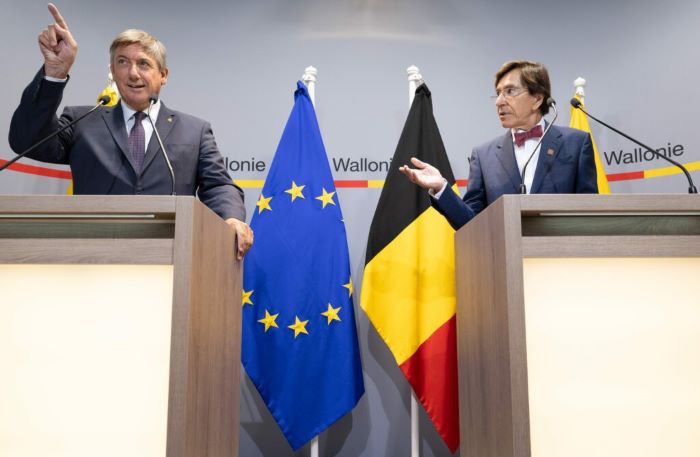
Photo – Flemish Minister President Jan Jambon and Walloon Minister President Elio Di Rupo. Credit: Belga/Benoit Doppagne