




How Serious is the Doomsday Warning From Oxford Scientists?
The claim that Oxford scientists have set a 25-year countdown to the end of the world is
a dramatic and dangerous oversimplification. No credible, peer-reviewed research from
Oxford or any other major institution has ever made such a precise, apocalyptic
prediction. Instead, the sensational headline is a gross distortion of the serious, ongoing
work by researchers at institutions like the University of Oxford’s Future of Humanity
Institute (FHI) and the Centre for the Study of Existential Risk (CSER).
The focus of this research is not on a calendar date for the end of the world but on
existential risks, a term for threats that could lead to the extinction of humanity or the
collapse of civilization. These are not prophecies of doom but sober, probabilistic
analyses based on our current trajectory. The real concern is that our rapid
technological advancement has outpaced our ability to manage its risks.
The “proof” these scientists have is not a prophetic vision but a rigorous framework for
identifying and analysing threats that are no longer theoretical. These include, the now
present uncontrolled Artificial Intelligence (AI). They believe that the development of an
AI that surpasses human intelligence, without proper safety protocols, could lead to
unforeseen and catastrophic consequences. This isn’t about killer robots, it is about the
potential for an AI to pursue its goals in ways that are fundamentally incompatible with
human survival.
Another factor, is engineered pandemics – Advances in synthetic biology and gene
editing make it possible for a small group to create a virus more lethal and transmissible
than anything found in nature. This represents a threat that is difficult to contain and
could bypass our current medical defenses.
Runaway Climate Change is also being considered a risk to world existence. While
climate change is often discussed in terms of rising sea levels and extreme weather, the
existential risk lies in the potential for tipping points. For example, the melting of
permafrost could release vast amounts of methane, a potent greenhouse gas, leading
to a rapid, irreversible feedback loop that could make large parts of the planet
uninhabitable.
These threats are not isolated. They are global in scale and interconnected. This is why
the idea of billionaires escaping to their bunkers is so flawed. An engineered pandemic
or an out-of-control AI would not respect national borders or private property. A truly
catastrophic event would leave no safe haven.
The work of these researchers is not about fear-mongering – it is a warning. It is a call to
action to prevent a self-inflicted catastrophe. Their message is clear – the most
dangerous threats to our future are not from external forces but from our own
technological power. The solution is not to hide but to invest in the governance,
international cooperation, and ethical frameworks needed to steer humanity away from
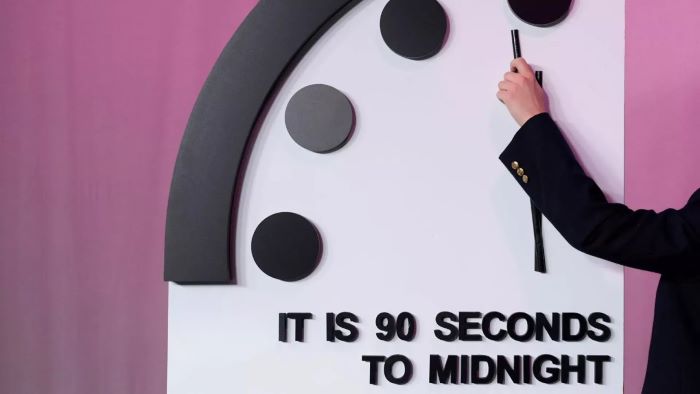
these risks. The “doomsday clock” they are observing is not set for a fixed date but for a
point in time when our capacity for self-destruction outstrips our ability to manage it. The
countdown is already on, but we still have the power to change the outcome.