







Belgian Farmers Turn Surplus Potatoes Into Community Harvests
Belgium’s potato farmers are turning to their communities to save crops from going to waste after an unusually strong harvest left producers with unsellable surpluses.
In the Walloon region, several farmers have begun inviting the public into their fields for “pick-your-own” days, selling potatoes directly at cut prices. The move has proved a win for both farmers and consumers, offering a way to reduce food waste while softening heavy financial losses.
In the village of Gaurain-Ramecroix near Tournai, residents arrived in droves earlier this month, filling bags with between 20kg and 130kg of potatoes each. The price – €0.30 per kilo, around a third of the supermarket rate, ensured steady demand.
“They’re cheaper, better quality and they last,” one customer, Marie-Christine, told Belgian broadcaster RTBF. “It’s a great idea.”
For farmers like Antoine Van Wynsberghe and his wife, Anaïs Bruneau, the scheme was born of necessity. A bumper yield this year left them with an extra 50 tonnes of potatoes, far beyond what they could shift through normal buyers. Factories had stopped purchasing, distributors were saturated, and the couple faced what they described as “a huge economic loss.”
“This is the first time we’ve opened our fields to the public,” Van Wynsberghe said. “The potato market is really disastrous this year. We couldn’t just give them to the cows.”
By selling directly, the farmers managed to recoup part of their investment while bypassing the costly steps of packaging and distribution. “Customers benefit, and so do we,” Van Wynsberghe added. “We save on labor and still get a decent rate.”
The model worked as more than 10 tonnes of potatoes were picked in a single morning. Encouraged by the turnout, neighboring farmers are preparing to host similar harvest days in the coming weeks.
What began as a desperate response to a glut has also highlighted how fragile food systems are in the face of shifting markets and changing weather patterns. Across Europe, potato farmers in France, the Netherlands and Germany have also faced volatile seasons, swinging between droughts that wither crops and sudden gluts that overwhelm markets. These extremes, sharpened by climate change, are exposing the vulnerability of staple foods to both the weather and the structures of industrial supply chains.
In that context, Belgium’s pick-your-own harvests offer more than just a community bargain: they are a glimpse of how resilience might be rebuilt. By shortening the distance between field and plate, and by involving consumers directly in the cycle of abundance and scarcity, farmers are finding creative ways to adapt to a future where climate and markets will be anything but predictable.
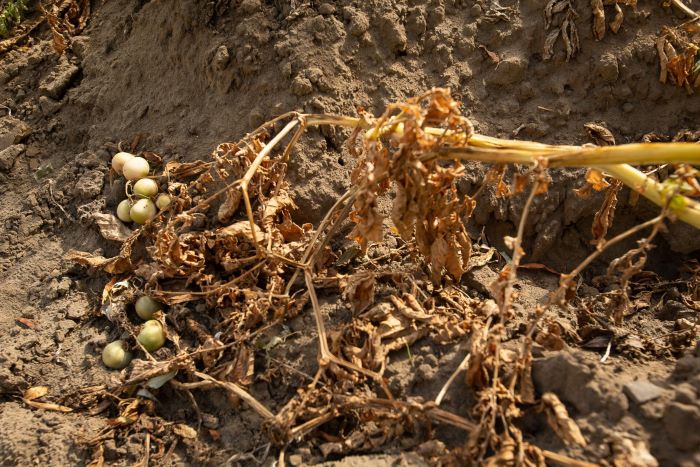
Photo – Dry potato plants pictured in De Pinte in July 2022. Credit: Belga/ James Arthur Gekiere