






Asteroid 2019 SU3 Will Not End the World – Scientists Allay Fears
Could the world face another extinction-level impact, the kind that wiped out the
dinosaurs and reshaped the planet? That question sent ripples of alarm across social
media after reports claimed that scientists were tracking an asteroid, 2019 SU3, with a
potential to hit Earth in 2084.
The answer, as it turns out, is reassuring. Asteroid 2019 SU3 is no planet killer. When
astronomers first detected the object, they noted a minute chance of a close approach
later this century. But with additional observations, its orbit was recalculated, and both
NASA and the European Space Agency swiftly removed it from their lists of potentially
hazardous asteroids. It poses no credible threat to Earth.
The scale of the misunderstanding lies in the size. The asteroid that doomed the
dinosaurs 66 million years ago – the one that left the 150-kilometre-wide Chicxulub
crater buried beneath Mexico’s Yucatán Peninsula, was roughly 10 to 15 kilometres
across. Its impact unleashed energy billions of times more powerful than modern
nuclear weapons, igniting global firestorms, tsunamis and years of choking darkness
that led to mass extinction.
By contrast, asteroid 2019 SU3 measures just about 15 metres wide, more a cosmic
pebble than a doomsday rock. It’s similar in scale to the meteor that exploded over
Chelyabinsk, Russia, in 2013, shattering windows, injuring some 1,500 people and
briefly lighting up the winter sky. That event, though dramatic, was a regional incident,
not a global one.
Still, the flurry of attention around 2019 SU3 reflects a deeper anxiety about how secure
the planet really is from space-borne hazards. Scientists say the odds of a world-ending
impact in our lifetime are vanishingly small. Events of that magnitude occur roughly
once every few tens of millions of years. More importantly, humanity now has both the
technology and coordination to spot and, potentially, deflect dangerous objects long
before they reach Earth.
Much of that effort centres on NASA’s Planetary Defense Coordination Office and its
counterparts in Europe, which monitor tens of thousands of near-Earth objects and
refine their orbits with precision. So far, none of the known large asteroids pose a threat.
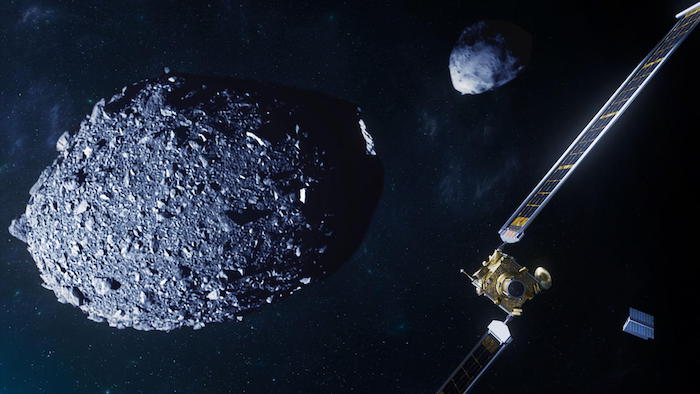
In 2022, NASA went a step further and proved that defence is no longer theoretical – the
DART mission deliberately crashed a spacecraft into a small asteroid moonlet named
Dimorphos, successfully altering its orbit by 32 minutes, far more than expected.
That kinetic impact test marked a turning point, showing that with sufficient warning
time, a dangerous asteroid could indeed be nudged off course. The greater challenge
now, experts say, lies not in facing an imminent impact, but in maintaining investment in
the sky-watching networks that can detect one early enough to act.
For now, fears of a catastrophic collision in 2084 can be put to rest. Earth, it seems, is
safe and the same science that once revealed our planet’s violent past is now ensuring
its protection for the future.