


France’s New Voluntary Military Service and the Fears Driving It
Emmanuel Macron’s announcement of a new voluntary military service scheme has landed in a political climate thick with anxiety. France, like much of Europe, is weighing a changing global order, increasingly volatile neighbours, and a domestic mood shaped by insecurity. The government’s insistence that “accelerating threats” justify a new recruitment push has prompted debate over what dangers the country is actually preparing for and how real they are.
At the heart of the president’s argument is a belief that Europe is entering a less predictable and more hostile era. French officials point to Russia’s ongoing war in Ukraine as the clearest illustration of hard-power politics returning to the continent. The fear in Paris is not only that Ukraine may falter, but that the conflict could spiral into broader confrontation or inspire provocations elsewhere. The French military establishment has been unusually blunt: the days of assuming long-term peace in Europe are over.
Layered on top of that are concerns about hybrid threats – cyber-attacks on critical infrastructure, disinformation campaigns, and covert destabilisation efforts that fall short of open warfare but can undermine states from within. France has been on the receiving end of sophisticated cyber intrusions targeting hospitals, transport systems, and government services, episodes officials say are tied to foreign actors testing Europe’s defences. Intelligence agencies have also warned of influence operations linked to Russia, Iran and other states hoping to exploit political polarisation.
The government has also widened its definition of threat to include instability across the Sahel, where France’s long-running counterterrorism efforts have been disrupted. Military withdrawals from Mali, Burkina Faso and Niger have left a region more hospitable to armed groups and foreign mercenaries. Paris fears that the ripple effects – migration pressures, extremist networks, weapons flows – will eventually land back at Europe’s door.
Domestically, terrorism remains a visceral risk even if major attacks have become less frequent. French security services continue to track radicalised individuals and disrupted several plots in recent years. The government argues that a more resilient, better-prepared civilian population, particularly among youth, is essential to maintain readiness in an unpredictable climate.
Whether these threats justify a new era of militarised citizenship is another question. Critics warn the government is overstating risks to build political momentum for policies that lean toward national service by another name. France already maintains one of Europe’s largest defence budgets, significant professional forces and a nuclear deterrent. Some opposition voices argue that boosting diplomacy, shoring up alliances and strengthening domestic cohesion would do more to confront modern dangers than expanding military volunteering schemes.
Supporters of the plan insist the threats are both real and evolving, and that France must adapt. They see the voluntary service as a way to rebuild civic unity, create a reserve of trained citizens and prepare the country for crises ranging from cyberattacks to natural disasters — not merely war. The Élysée has framed the initiative as a civic project rather than a prelude to conscription, though the messaging has done little to ease suspicions among the public.
What is undeniable is that France, like its neighbours, is trying to position itself for a world it no longer feels entirely in control of. The “accelerating threats” Macron cites may differ in nature – some distant, some intangible, some immediate but they collectively point to a Europe increasingly conscious of its vulnerabilities. Whether voluntary military service will meaningfully address those concerns remains to be seen, but the politics of preparedness have become a defining feature of the moment
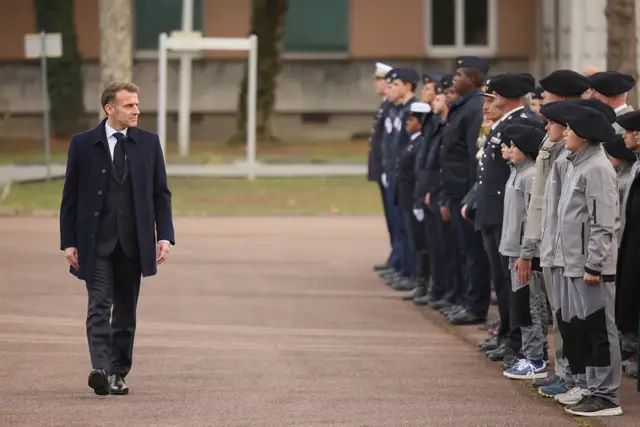
Photo – Emmanuel Macron reviews troops and students of an army high school prior to his speech (Thomas Padilla/AP