








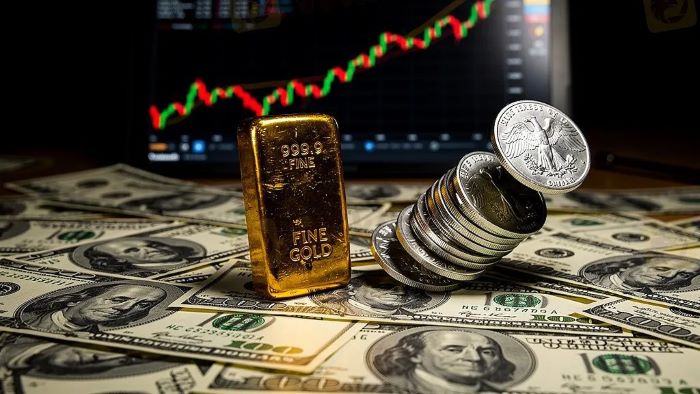
Geopolitics, Gold, Silver and Dollars
What looks like turbulence in the gold and silver markets is better understood as a stress test of a global financial order that has long lost its anchor in production, labor, and material reality. The recent swings in precious metal prices have been read by mainstream financial media as panic or speculative excess. That reading is shallow. What we are witnessing instead is a recalibration of value in a world edging toward de-dollarization, geopolitical fracture, and the slow exhaustion of financialization as a governing ideology.
Short term pullbacks in gold and silver prices have little to do with fundamentals. They are driven by hedge fund profit taking, algorithmic momentum trading, stop loss cascades, and the familiar choreography of automated finance. These forces are temporary by design. They work themselves through the system and move on. What remains intact is the structural trend. Gold and silver continue to mark historic highs on a yearly basis. Silver remains roughly double its value from a year ago, while gold has risen dramatically over the same period. These movements punish short term traders but reward those who understand metals as stores of value rather than chips in a casino.
The deeper drivers are macroeconomic and political. Persistent inflation continues to erode real wages. Unemployment is understated. Housing affordability remains structurally unresolved. Public debt in the United States has crossed levels that would have triggered emergency measures in any other country lacking reserve currency status. Against this backdrop, the dollar’s dominance rests less on productive strength than on habit, coercion, and the lingering memory of trust that is now being steadily depleted.
President Trump’s return to aggressive tariff policy, gunboat diplomacy, and threats of territorial expansion reveals the political nature of currency value. The dollar has been weaponized through sanctions, trade restrictions, and financial surveillance. This has accelerated the very process Washington claims to oppose. The shift toward alternative settlement mechanisms within BRICS and beyond is not ideological theater. It is a rational response by states seeking insulation from arbitrary power. De-dollarization is no longer speculative. It is operational, uneven, and irreversible.
Financialization has for decades inverted the relationship between production and value. Stock markets have become superstructures floating above material economies, increasingly detached from supply chains, labor conditions, and ecological limits. They function less as allocators of capital and more as arenas for leveraged speculation dominated by large institutional players. Retail investors are invited in at peaks and expelled during corrections. The result is recurring wealth transfer upward, masked as market efficiency.
In this context, precious metals regain relevance precisely because they sit outside the abstractions of modern finance. Gold is not a promise. It is not a derivative. It is not dependent on policy credibility or software updates. Silver carries a dual character that is often overlooked. It is both a store of value and an indispensable industrial input, critical to electronics, energy systems, and advanced manufacturing. This twofold role anchors silver in real production while preserving its monetary function, a combination few assets can claim.
Portfolio composition in times of systemic uncertainty should reflect this reality. Precious metals should not be treated as speculative bets but as ballast. A prudent allocation in the range of 15 to 25 percent split between gold and silver offers protection against currency volatility, equity market dislocation, and geopolitical shock. Silver deserves a larger share within that allocation due to its industrial demand and chronic supply tightness. The remainder of a portfolio should favor assets tied to tangible production rather than financial engineering.
Cryptocurrencies are often marketed as alternatives to fiat money, yet they replicate many of the same abstractions without the institutional backstops. They have no intrinsic use value, no industrial application, and no material constraint. Their price depends entirely on belief, liquidity, and narrative momentum. In moments of crisis, these are precisely the qualities that evaporate first. As instruments of speculation, cryptocurrencies fit seamlessly into the logic of financialization they claim to resist.
Artificial intelligence occupies a similar ideological space. Investment has surged far ahead of demonstrated returns. The infrastructure costs are enormous, the revenue models uncertain, and the concentration of capital extreme. AI is not a substitute for value storage, nor does it resolve the instability of monetary systems. Its current valuation presupposes endless growth, cheap energy, and social acceptance of widespread displacement. These assumptions are fragile. Both short and long term, AI investment carries significant risk of liquidation rather than salvation.
Gold and silver, by contrast, do not promise utopia. They offer continuity. They persist across political regimes, technological cycles, and ideological shifts. As the world moves toward a multipolar order and the dollar’s supremacy wanes, the question is not what digital construct will replace it, but what material anchors will stabilize value during the transition.
The recent volatility in metals markets is not a warning against them. It is a reminder of why they matter. In a global economy strained by debt, militarized trade, and speculative excess, the turn toward precious metals reflects a rational search for solidity. The contradiction between financialization and production is beginning to close. When it does, gold and silver will not look like relics of the past, but instruments of survival in an uncertain future.
David Danisa