





Luxembourg’s “Smart City” Policy Meets Reality of Daily Life
In Luxembourg the idea of the smart city has quietly shifted from policy jargon to something that can touch daily routines. From how we move through our neighbourhoods to how energy is conserved in public buildings, the latest round of government-backed innovation projects offers a revealing snapshot of how this transition is unfolding on the ground.
Out of fifteen proposals submitted by municipalities such as Luxembourg City, Esch-sur-Alzette, and Differdange, five were selected for funding, with three focused on mobility, one on resources, and one on energy.
Six eligible projects were presented in January to the Climate and Energy Fund, operating under the auspices of the Ministry of the Environment, Climate and Biodiversity, to confirm results-based financing, while four others deemed relevant but ineligible were redirected to the Environmental Protection Fund and the Water Management Fund, which are also overseen by the ministry. Approvals are already moving ahead for some of these redirected projects.
This distribution tells a story about priorities in a small country with big ambitions. Mobility remains the heart of the smart city conversation. Anyone who has waited for a late bus or searched for a parking space in Luxembourg City knows that digital tools that optimise traffic flows or improve shared transport are not abstract innovations but potential quality-of-life upgrades.
Energy and resource projects, while less visible, shape comfort and costs in homes, schools, and public spaces. Smarter monitoring translates into warmer rooms in winter and, at the municipal level, into more efficient budgeting with implications for local taxes.
What makes this initiative noteworthy is the rigorous way projects were evaluated. Beyond technical quality and novelty, jurors assessed social and environmental impact, the ambition of key performance indicators, and the robustness of data practices including cybersecurity and interoperability.
In everyday terms this means that a clever app is not enough if it does not protect residents’ data, cannot be adapted elsewhere, or fails to demonstrate actual reductions in emissions or resource use. The emphasis on replicability hints at a future where solutions trialled in one commune, such as Esch-sur-Alzette, can be adopted in others, allowing innovation to ripple outward rather than remain isolated experiments.
There is also a subtle cultural shift at play. The initial selection was presented publicly to inspire more municipalities to join the second round of applications due in mid-March. This competitive yet collaborative spirit reflects a maturing smart city ecosystem in which towns learn from one another and borrow what works. Digital sustainability is no longer the preserve of tech-heavy cities alone but a shared toolbox for rural and urban communities alike.
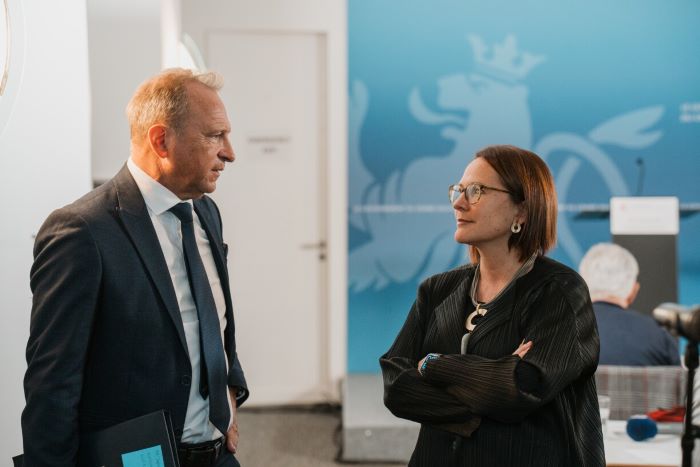
Ministers Lex Delles of the Ministry of the Economy and Serge Wilmès of the Ministry of the Environment, Climate and Biodiversity have framed these projects as practical levers for ecological transition rather than flashy ends in themselves. Residents may not cheer for sensors or dashboards, but they will notice safer cycling routes, cleaner water management, and public spaces that feel more responsive to how people actually live.
The funding decisions now moving forward suggest that Luxembourg is edging closer to that ideal. The true measure will be whether these projects deliver tangible changes that people can feel in their commute, their comfort, and their sense of belonging in greener, more efficient neighbourhoods.
Moji Danisa
Image – ©Orsys