




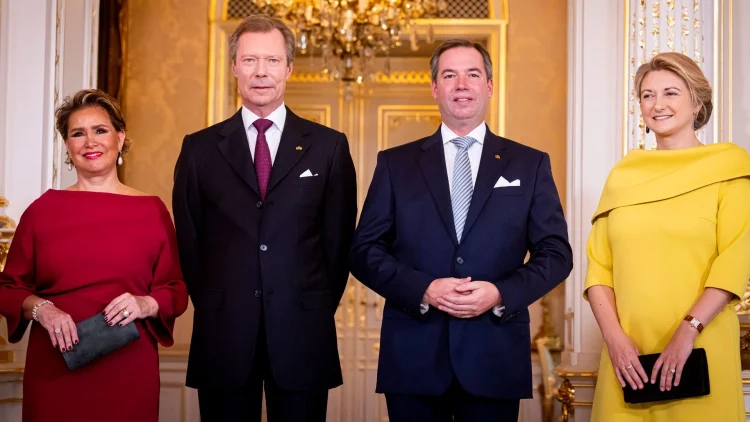
Luxembourg Prepares to Celebrate National Day as Grand Duke Henri’s Abdication Nears: A Look Back at 25 Years of Royal Legacy
As Luxembourg prepares for its 25th National Day celebration under the reign of Grand
Duke Henri, the country stands at a historic turning point. With the Grand Duke set to
abdicate in October, the annual festivities will take on a deeper significance, marking not
just a national celebration, but a moment of royal transition and reflection on a
remarkable legacy.
Since his oath of office before the Chamber of Deputies on October 7, 2000, Grand
Duke Henri has quietly but powerfully shaped Luxembourg’s identity, guided by
constitutional principles, moral clarity, and a deep commitment to humanitarian causes.
Over the past 25 years, his reign has seen dramatic global changes, domestic
evolution, and a royal household increasingly defined by modern values.
In a symbolic gesture, the state has commemorated 40 key milestones from his reign,
spanning diplomatic achievements, social progress, royal milestones, and national
challenges from the founding of the University of Luxembourg (2003) and Luxembourg’s
EU Council Presidency (2005) to the legalisation of same-sex marriage (2014) and the
adoption of a new Constitution (2023).
Grand Duke Henri’s leadership has also been tested by moments of crisis. His sensitive
handling of the 2008 Euthanasia Law debate, when he expressed moral reservations
without disrupting democratic procedures, showcased a monarch deeply attuned to
ethical responsibilities. His presence during the COVID-19 pandemic’s onset in 2020,
and his symbolic unity with the public during the passing of his father, Grand Duke Jean,
in 2019, reinforced his role as a steadying figure in turbulent times.
Equally impactful has been the work of Grand Duchess Maria Teresa, whose advocacy
on global issues, from women’s rights and conflict-related sexual violence to learning
disabilities and humanitarian missions; has expanded the duchy’s soft power on the
world stage. Her initiatives such as the “Stand Speak Rise Up” forum (2019) and her
designation as UNICEF’s Eminent Children’s Advocate (2005) have further deepened
the royal family’s moral imprint.
The royal household has also embraced renewal. The wedding of Hereditary Grand
Duke Guillaume in 2012, the birth of Prince Charles in 2020, and the appointment of
Guillaume as Lieutenant-Representative in 2024, all signal a smooth and carefully
planned transition. The future of the monarchy appears both secured and revitalized.
As Luxembourg heads toward the Grand Duke’s official abdication in October, following
his leadership at Luxembourg Day at the Osaka World Expo in May 2025, there is a
palpable mix of gratitude and anticipation. His abdication will mark not just the end of a
reign, but the close of a royal chapter defined by quiet dignity, constitutional integrity,
and a consistent moral compass.
The monarchy in Luxembourg is largely symbolic, but under Grand Duke Henri, that
symbolism has carried weight, anchoring national unity, representing the country
abroad, and embodying values that have resonated across generations. His legacy is
one of evolution without disruption, where tradition has remained intact even as the
nation modernised.
As the country prepares for the official National Day celebrations on June 23, it does so
with a sense of pride and reflection. Luxembourg is not merely celebrating a national
holiday; it is honouring a royal era, one that has stood firm in a changing world, and that
now, with grace, prepares to pass the torch.