



When the Sheriff Sanctions the Judge
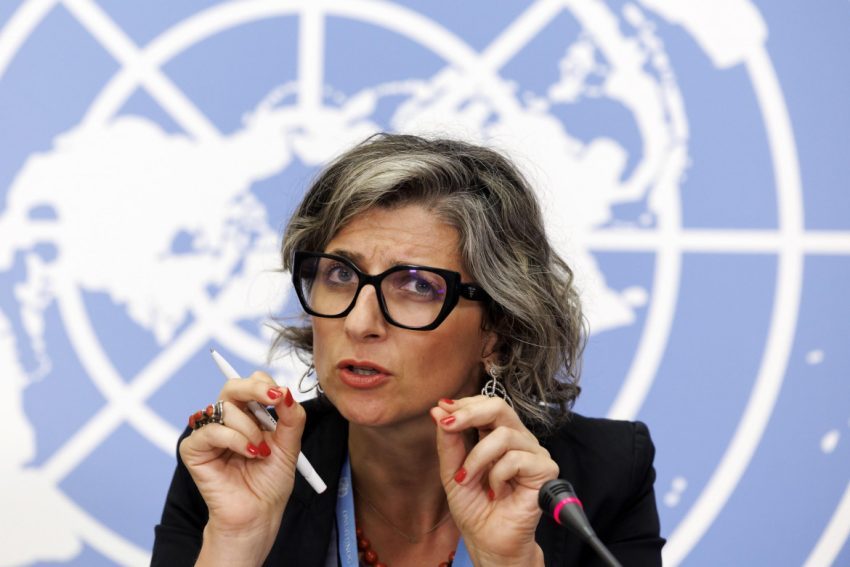
The United States’ decision to sanction Francesca Albanese, the UN special rapporteur investigating human rights abuses in Gaza, represents a profound fracture in the architecture of international justice. It is difficult to comprehend how, in the names of natural justice, equity and good conscience, Washington finds moral authority to punish an officer whose mandate is precisely to shine light on war crimes. The irony is as stark as it is unsettling. At its heart, this action signals that power, when unchecked, will not merely shield itself from scrutiny but will actively muzzle the very instruments of accountability.
Consider the raw facts. Israel’s bombardment of Gaza has resulted in over 57,000 Palestinian deaths, with the vast majority unarmed civilians, including women and children. In contrast, Hamas’ attacks that ignited this round of violence killed roughly 1,200 people. Yet while the world is quick to recognize the horror of Hamas’ October 7 assault, it appears hesitant to apply the same moral calculus to the industrial-scale devastation wrought by Israel’s response. That the United States now finds it appropriate to sanction a UN official for calling out this staggering asymmetry reveals a chilling double standard.
The international system rests on fragile but vital pillars: the rule of law, collective norms and the consent of global society. When the US, by far the world’s most powerful actor, decides to target an investigator for doing her duty, it sends a dangerous message that might makes right. This cuts to the heart of the social contract that sustains international institutions. The UN, the International Criminal Court, and countless treaties only function because states, even powerful ones, accept limits on their behavior. By punishing Albanese for documenting potential war crimes, the US undermines this consent and invites a world governed purely by coercion.
History offers sobering lessons on the consequences of such arrogance. NATO’s intervention in Kosovo under Resolution 1244, and the UN Security Council’s authorization of force in Libya under Resolution 1973, were justified on grounds of protecting civilians from mass atrocities. Those same doctrines are now conspicuously absent in Gaza. To wield the machinery of international order to intervene in Yugoslavia or Libya, yet decry it as “false and offensive” when applied to Israel, exposes an extraordinary moral inconsistency. These precedents are not just dusty footnotes; they live on in the expectations of peoples everywhere who watch and wonder whose blood truly matters.
There is a deeper peril. The very legitimacy of international law hinges not merely on formal resolutions but on the belief by the “peoples of the world” that these laws stand above brute power. When that faith erodes, the entire edifice teeters. If the rules only bind the weak, while the strong wield them like cudgels of convenience, why should any nation or community respect them? The consequences will be felt far beyond Gaza or Tel Aviv. Other states, organizations and future generations may well decide that since the system is rigged, they owe it no loyalty.
It also carries a profound lesson for those who still believe they possess an unassailable monopoly on “agency” in world affairs. For decades, control over global media narratives and the architecture of international finance allowed certain powers to dictate whose suffering was visible and whose was dismissed under the rubric of “affaires d’etat.” That age is fading. The digital revolution, grassroots movements and a growing skepticism of official narratives mean publics are no longer passive recipients of geopolitical theater. They are participants, often unruly ones, who demand consistency between words and deeds.
To imagine that things will always remain as they have been is fantasy. Agency is on trial. The world is not as easily choreographed as it once was. The spectacle of the US sanctioning a UN investigator for exposing mass civilian deaths, while standing shoulder to shoulder with the perpetrator, lays bare prevarications so obvious that even the most carefully managed narrative cannot conceal them. It risks accelerating a broader loss of faith in the system that, imperfect as it is, still stands between us and global anarchy.
The ultimate question then becomes not about Francesca Albanese or even about Israel alone. It is about whether we can preserve an international order where justice is not the privilege of the powerful but the right of all. If natural justice, equity and good conscience are cast aside for the sake of short-term alliances, we may soon find there is nothing left to stand on when next the powerful decide that rules do not apply to them.
David Danisa