








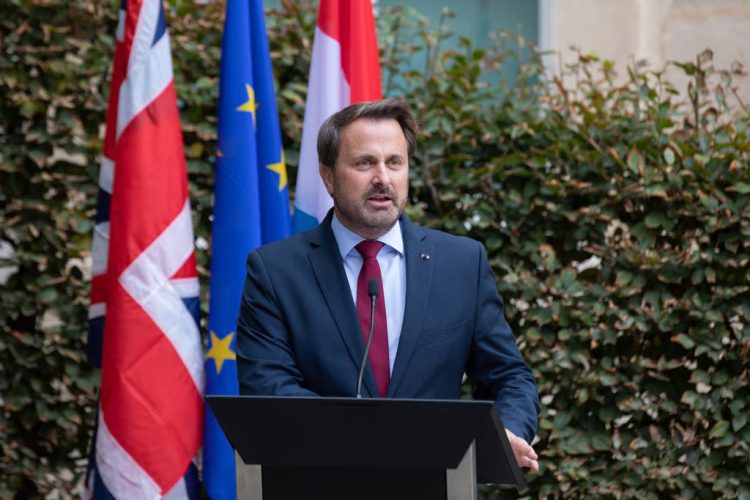
“Is Diplomacy Still Alive in the Iran-Israel Conflict?” Bettel’s Bet
As Israeli jets patrol the skies above Gaza and U.S. warplanes strike Iranian nuclear sites, Luxembourg’s Foreign Minister Xavier Bettel stands almost alone in voicing what now seems like a fading hope, diplomacy. In recent remarks following renewed U.S. military action in the region, Bettel warned that no viable solution will emerge from airstrikes and retaliation. His statement, though diplomatic in tone, was a stark critique of a rapidly escalating conflict with roots reaching deep into the domestic political landscapes of Washington, Tehran, and Jerusalem.
Bettel’s position, shared quietly by many in Brussels and Berlin, calls for a return to negotiations between the U.S., Iran, and Israel. But the question looms: can diplomacy, undermined and bloodied, still be revived?
The United States’ erratic policy toward Iran, defined by hardline unilateralism under Donald Trump and lukewarm engagement under Joe Biden, has left the region with little consistency. Trump’s 2018 withdrawal from the Joint Comprehensive Plan of Action (JCPOA) dismantled a rare multilateral achievement. The “maximum pressure” campaign failed to prevent Iran’s nuclear acceleration, and in fact may have emboldened it. Now, under Trump’s second term, the renewed military action is being cheered by domestic hawks and pro-Israel constituencies, but met with concern by a divided Congress and an exhausted foreign policy establishment.
Bettel’s appeal to diplomacy finds little resonance in Washington, where foreign policy is increasingly held hostage to electoral cycles and partisan brinkmanship. With a presidential election looming in 2028, few U.S. politicians want to appear “soft” on Iran. The political calculus is simple: strength sells, especially when sold as defense of Israel.
In Iran, the leadership remains defiant, with even moderates echoing hardliner rhetoric about Western aggression. While internal dissent over the economy, women and “minority rights” remain widespread, the regime has managed to unify public opinion against foreign military threats. Iranian Foreign Minister Abbas Araghchi was quick to label the latest U.S. strikes as proof of Washington’s unreliability.
There is no meaningful domestic pressure on the Iranian government to re-engage with diplomacy—particularly with an adversary that continues to strike militarily and refuse sanctions relief. If anything, recent developments have strengthened the position of the Islamic Revolutionary Guard Corps (IRGC), which views diplomacy with deep suspicion.
In Israel, Prime Minister Benjamin Netanyahu’s increasingly hardline coalition depends on a permanent state of national security urgency. The Iranian threat—real, perceived, or politically inflated—functions as both justification and distraction. Domestically, Israel is experiencing a rightward shift, with centrist voices sidelined by ongoing war in Gaza, tensions in the West Bank, and fears of Hezbollah along the northern border.
Netanyahu, long a critic of the JCPOA, appears in no mood for compromise. His government sees the elimination of Iran’s nuclear potential as an existential imperative, and is unlikely to tolerate a return to the diplomatic status quo ante, especially as regional conflicts multiply.
The Israel-Iran conflict does not exist in isolation. Neighboring countries—Lebanon, Syria, Iraq, and Yemen—are drawn in, either as battlegrounds or through proxy involvement. Gulf states like the UAE and Saudi Arabia, though wary of Iran’s regional reach, have re-calibrated their positions, recently engaging in tentative de-escalation with Tehran.
Their response to the current crisis is muted. There is little appetite among Gulf monarchies for a full-blown regional war, especially with oil markets and internal reforms at stake. Yet none are in a position to meaningfully broker peace.
Luxembourg is not a military power, nor a traditional Middle East player. But Xavier Bettel’s voice matters as a barometer of what remains of Europe’s diplomatic conscience. His insistence on dialogue, trust-building, and multilateralism offers not just an alternative policy path—but a critique of the moral failure that comes with endless escalation.
The question, however, is whether anyone is listening.
In a region where war has become routine and diplomacy a punchline, Bettel’s approach may seem naïve. But in truth, it is one of the last viable cards the West has. It recognizes what bombs cannot achieve: enduring security built on compromise, not annihilation.
As one senior EU diplomat told this reporter, “Diplomacy may be bleeding, but it hasn’t flatlined. If we let it die, the alternative won’t be peace—it will be forever war.”
And that, Bettel warns, is a cost Europe and the world can no longer afford.
Photo – Xavier Bettel, Deputy Prime Minister and Minister for Foreign Affairs