








Kagame, the West and Politics of Africa’s Great Lake Region
Paul Kagame grew up in a refugee camp in Uganda, with deep bitterness toward the pro-French Hutu regime in Kigali. His early influences were shaped by this adversity and by friendship with Major General Fred Rwigyema, a key figure in the Rwandan Patriotic Front (RPF). Rwigyema planned and initially led the 1990 invasion of Rwanda, but was shot as soon as his troops crossed into Rwanda, an event that provided Kagame the opportunity to lead the RPF’s invasion of the country.
What stands out from the beginning was Kagame’s aversion to France and Belgium backed Hutu state in Kigali, and ultimately the Hutu regime of President Juvénal Habyarimana. This sentiment was ingrained early in his life and remains a cornerstone of his political ideology.
Alongside Rwigyema, Kagame joined Uganda’s Yoweri Museveni’s guerrilla movement, though their aims were never fully aligned with Uganda’s national interests. This was a movement focused on overthrowing the Rwandan government, not Ugandan issues. Museveni, for his part, had to manage these Swahili-speaking Tutsi militants within his ranks, much like he managed the Laurent Kabila–led revolutionaries in Uganda, who were also preparing to invade Congo.
These forces were united by a common goal—to challenge the French-speaking colonial influence in Central Africa and to alter the balance of power in the region. With both missing the key factor that in geopolitical contests, Western powers, regardless of their individual colonial histories or languages, unite against natives in exploiting wealth abroad. Whether French, English, Belgian, or American, the West work as a single block when the issue is resource extraction, economic exploitation and political oppression.
Kagame’s deep-seated dislike of the French-backed regime in Rwanda, while important, is largely irrelevant in the larger context of geopolitics in Africa’s Great Lake region. Nonetheless, Kagame’s opposition to the French may not have been a personal vendetta either, but a calculated political stance, reflecting a “practical“ view of regional politics. His subsequent alignment with Washington may appear strategic in part. A vision that gifted the United States an opportunity to mold Kagame into a client leader who could further U.S. interests in Central Africa. Kagame, much like Joseph Mobutu or Moise Tshombe, perhaps misjudge the tide of politics in the Great Lakes.
Kagame’s education, particularly the time he spent in the U.S. Army Command and General Staff College (CGSC) in Fort Leavenworth, Kansas, apparently solidified his confidence in American support as a decisive factor in power relations. The extent to which his time in the U.S. military education system shaped his worldview is likely significant.
Then there is the curious case of Luxembourg’s involvement in Rwanda. Seemingly far removed from the usual powers that shape Central African politics, Luxembourg’s presence in Rwanda seems opportunistic.
While Rwanda is often presented as a success story, Luxembourg’s financial interests are not aligned with the country’s broader development needs. Rather, Luxembourg’s investment in Rwanda serves to consolidate the interests of international capital, particularly in the mineral extraction industries of the Great Lakes region.
Rwanda’s economic “success” story under Kagame isn’t contrived. But the ceaseless celebration of this in the mainstream Western press seems motivated by other interests. A desire to further entrench access and control of the region’s vast resources for global capital might seem a motivating factor.
As for Luxembourg’s presence in the Great Lakes, it may be understood not as an expression of Luxembourg’s national interest, but as part of a larger neocolonial project, i.e., as a proxy for larger Western corporate and political interests. In fact, many of the companies operating in Rwanda under Luxembourg’s banner have shadowy ownership ties to multinational corporations based in the U.S., Belgium, France, the Netherlands, etc. Luxembourg’s aid, far from being an act of national charity, is designed to secure Western corporate interests in the region.
The United States. As much as Washington’s approach to Rwanda and the broader Great Lakes region appear to have shifted over the years, most recently under Presidents Biden and Trump, not much changed. Though the U.S. has taken actions that mimic shoving aside traditional European interests, in reality western interest in this region of the world was always consolidated. President Biden’s promise to reconstruct railways in Angola and Congo, along with Trump’s efforts to end the Congo–Rwanda conflict, are not exclusively American. They remain unopposed in every western capital.
Kagame’s reliance on force to consolidate power within Rwanda, and his exclusion of significant segments of the Rwandan political landscape, represent a deep flaw in his political strategy. His refusal to reconcile with opposition forces, both domestically and in the broader Great Lakes region, mirrors the mistakes of past leaders such as Mobutu Sese Seko. Mobutu, too, believed that he could outwit his “jealous neighbors,” set competing Western interests against themselves, while maintaining an authoritarian grip on power.
In the context of Western interests, there is no dividing Western interests.
Kagame’s regime, though seemingly secure today, rests on fragile foundations. His dependence on Western backing, coupled with authoritarian rule, mirrors the path taken by past African leaders who believed they could withstand both internal dissent and regional anti-regime forces. Ultimately, the survival of his regime would be neither guaranteed nor enforced by continued alignment with Western démarches, nor by the “beguiling amity” of American and European political figures.
David Danisa
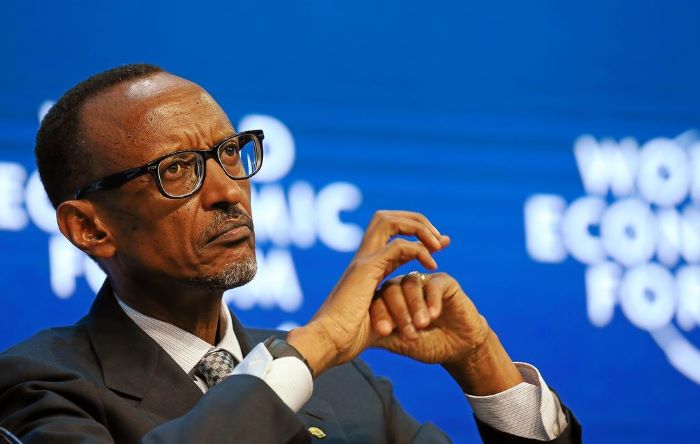
Photo – Rwanda’s President Paul Kagame. Credit: WEF/Monika Flueckiger.