


What NATO Visit Means for Luxembourg and the Arctic
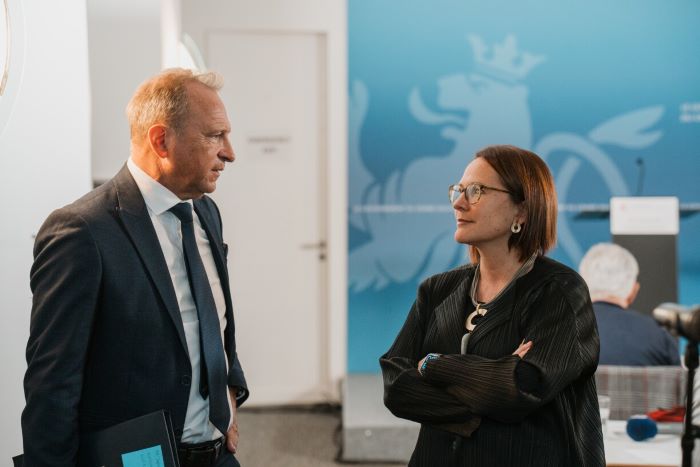
When NATO’s top military commander touched down in Luxembourg to discuss an upcoming Greenland-related mission, it was not about deploying tanks from the grand duchy to the Arctic. It was about something more subtle and, in many ways, more important – how even the alliance’s smallest members fit into a rapidly changing strategic landscape.
The visit comes at a moment when Greenland, long viewed as a remote outpost, has moved to the center of global geopolitics. Melting ice is opening new shipping routes. Rare earth minerals and other resources are attracting interest. And the island’s location between North America, Europe, and Russia gives it outsized military significance.
For NATO, the Arctic is no longer a peripheral concern. It is becoming a frontline region.
Luxembourg has one of the smallest armed forces in the alliance. It does not have Arctic-capable brigades or ice-hardened warships. But the country has built a reputation in areas NATO increasingly values, such as satellite communications, cyber capabilities, logistics and financial contributions to joint missions.
In recent years, Luxembourg has invested heavily in military space assets and joint projects with allies, positioning itself as a key enabler rather than a frontline combatant. That makes it relevant to Arctic planning, where surveillance, communications, and coordination across vast distances are essential.
The NATO commander’s visit was therefore less about troop numbers and more about alignment – ensuring that Luxembourg’s technical capabilities and political support are integrated into a broader alliance strategy.
For a country that has long relied on collective defence, being visibly engaged in NATO planning is also a strategic signal. It reinforces Luxembourg’s reputation as a dependable ally at a time when defence commitments across Europe are under renewed scrutiny.
Greenland belongs to the Kingdom of Denmark and is covered by NATO’s collective defence clause. But the island’s growing strategic value has sparked new debates within the alliance, particularly as global powers increase their Arctic presence.
For NATO, the central concern is not an immediate military confrontation but the long-term balance of influence. Russia has expanded its Arctic bases. China has shown interest in polar infrastructure and resources. And the United States continues to see Greenland as a critical part of its early-warning and missile-defence network.
In this context, NATO’s planning for Arctic missions is aimed at deterrence, surveillance, and coordination rather than large-scale deployments.
The question whether Europe can stand on its own against the so called super powers, often raised in discussions about Greenland, borders on worries that European NATO members may not match American or Russian military power if strategic interests diverge.
In purely military terms, the United States remains the dominant force within the alliance. Its defence spending, logistics, and global reach far exceed those of any individual European country.
But NATO is not built on individual strength. It is built on collective capability.
Together, European members field large armies, advanced air forces, and two nuclear powers in France and the United Kingdom. In a coordinated operation, they could mount a credible defence of Greenland – especially with Denmark, Norway, and other northern allies providing local expertise.
The challenge is less about firepower and more about cohesion, logistics, and political will.
For Luxembourg, the significance of the NATO commander’s visit lies in what it represents – a shift in how security is defined.
In the past, small states contributed mainly through symbolic troop deployments. Today, their value often lies in technology, financing, intelligence, and diplomatic support. Luxembourg’s space and communications capabilities make it particularly relevant in a region where distances are vast and infrastructure is sparse.
The Arctic is becoming a proving ground for NATO’s unity. And in that test, the contribution of a small but committed member like Luxembourg may matter more than raw military weight.
In the cold calculus of Arctic geopolitics, even the smallest state can help shape the balance – if it knows where its strengths lie.
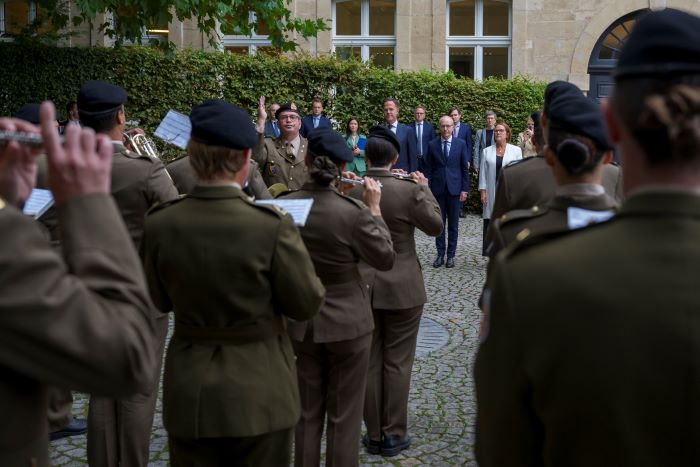
Photo (from l. to r.) Mark Rutte, Secretary General of the North Atlantic Treaty Organization (NATO); Luc Frieden, Prime Minister; Yuriko Backes, Minister of Defense© SIP / Jean-Christophe Verhaegen